What are the exceptions to the truck driving ban in Germany?
The German system provides for a precisely defined list of exceptions set forth in § 30, paragraph 3, items 1–4 of the StVO and § 2 of the Ferienreiseverordnung. These exceptions are designed, on the one hand, to ensure the continuity of supplies of essential goods and the operation of intermodal transport, and, on the other hand, not to undermine the overall purpose of the bans, which is to reduce traffic congestion and improve safety.
Intermodal rail-road transport
Pursuant to § 30, paragraph 3, item 1 of the StVO and § 2, item 1 of the Ferienreiseverordnung, combined rail-road transport is fully exempt in the following cases. First, transport from the shipper (Versender) to the nearest suitable rail loading terminal (nächstgelegener geeigneter Verladebahnhof) within a radius of up to 200 kilometers. Second, transport from the nearest suitable rail unloading terminal (nächstgelegener geeigneter Entladebahnhof) to the consignee (Empfänger) within a radius of up to 200 km. Third, the transport between rail terminals as part of intermodal container and semi-trailer transport.
The key concept is the “nearest suitable terminal” (nächstgelegener geeigneter Bahnhof). You cannot choose just any terminal within a 200-km radius; the terminal must actually be the nearest one and technically suitable for loading the specific type of cargo. For example, if you are transporting 40-foot containers and the nearest terminal within a 150-km radius only handles 20-foot containers, you may go to a more distant terminal with the appropriate equipment, provided that it is the nearest terminal with such infrastructure.
Intermodal Transport: Seaports and Inland Ports
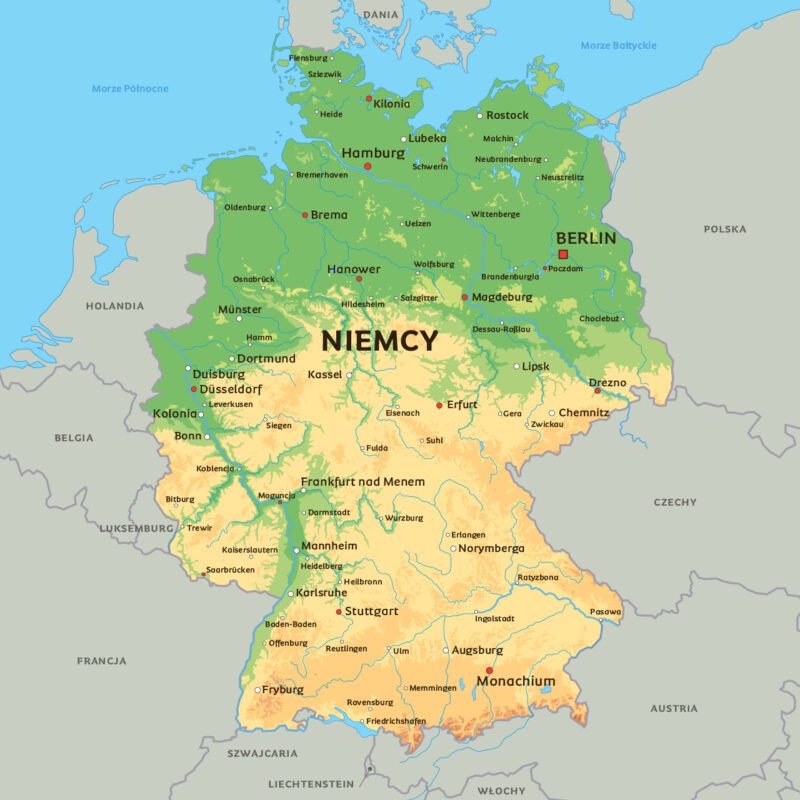
Pursuant to § 30, paragraph 3, item 1 of the StVO and § 2, item 1 of the Ferienreiseverordnung, transportation to and from seaports (Seehäfen) and inland ports (Binnenhäfen) within a radius of up to 150 kilometers from the port. This applies to the major seaports: Hamburg (Germany’s largest container port), Bremerhaven, Wilhelmshaven, Rostock, Lübeck, and key inland ports on the Rhine (Duisburg—Europe’s largest inland port, Cologne, Mannheim, Karlsruhe), the Oder (Szczecin/Świnoujście for shipments to Poland), and canals (Mittelland Canal, Main-Danube Canal).
The exemption covers both transport from the shipper’s warehouse to the port for loading onto the vessel and transport from the port, after unloading from the vessel, to the consignee’s warehouse. The required documentation includes the bill of lading (Bill of Lading – B/L) or a booking confirmation verifying the reservation of space on the vessel, along with proof of the distance from the loading/unloading location to the port (e.g., a printout from a GPS navigation system, a copy of a map with the route and mileage marked).
Fresh food (frische Lebensmittel)
In accordance with § 30, paragraph 3, item 2 of the StVO and § 2, item 2 of the Ferienreiseverordnung, the transport of fresh food products (frische Lebensmittel) is completely exempt. The list includes: fresh milk and dairy products (frische Milch, frischer Joghurt, frischer Quark, frische Butter, frischer Käse—fresh, unaged cheese), fresh meat and cold cuts (frisches Fleisch, fresh sausage products—unsalted sausages and cold cuts), fresh fish (fresh fish—unsmoked, unfrozen, and unsalted), and perishable fruits and vegetables (perishable fruits and vegetables).
The key terms are “frisch ” (fresh) and ” leichtverderblich ” (perishable). Frozen foods (gefrorene Lebensmittel), canned foods (konservierte Lebensmittel), vacuum-packed foods with a long shelf life, dried foods (getrocknete Lebensmittel), or foods preserved in other ways to prevent spoilage do not qualify for the exemption. In practice, this means that frozen French fries, frozen pizza, frozen vegetables, frozen meat, vacuum-packed aged cheese, and UHT milk— none of these products are covered by the exemption and may not be transported on Sundays and holidays.
Fruits and vegetables are particularly controversial. The exemption applies only to perishable products, such as strawberries, raspberries, lettuce, asparagus, and ripe tomatoes. On the other hand, potatoes, onions, carrots, and cabbage—as products with a longer shelf life—do not formally qualify for the exemption, although in practice, inspectors often consider them exempt when transported directly from farms to points of sale.
Live animals and fish (lebende Tiere und Fische)
In accordance with § 30, paragraph 3, item 2 of the StVO and § 2, item 2 of the Ferienreiseverordnung, the transport of live animals (lebende Tiere) and live fish (lebende Fische) is completely exempt. The exemption covers all types of live animal transport: cattle (Rinder) to slaughterhouses or between farms, pigs (Schweine) to slaughterhouses or breeding facilities, sheep and goats (Schafe und Ziegen), horses (Pferde)—including transport for sporting events—poultry (Geflügel)—chickens, turkeys, ducks, and geese—to farms or slaughterhouses, and other farm animals.
The exemption also applies to live fish transported in tanks with oxygenated water (Fischtransporte in Wassertanks mit Sauerstoffversorgung) to fish farms (Fischzuchtanlagen), the sale of live fish in restaurants and fish markets, and the transport of juvenile fish (Jungfische) for stocking ponds and lakes. Transport must be carried out in accordance with the Tierschutztransportverordnung (Regulation on the Protection of Animals During Transport), which specifies maximum transport times, temperatures, and requirements for watering and feeding the animals.
ADAC Roadside Assistance and Emergency Services Vehicles
A specific German exemption applies to roadside assistance vehicles (Pannenhilfefahrzeuge), in particular the fleet of the ADAC (Allgemeiner Deutscher Automobil-Club), Europe’s largest roadside assistance organization. ADAC vehicles may operate on Sundays and holidays to assist drivers, tow vehicles after a breakdown, deliver fuel on the highway (Kraftstofflieferung), and perform minor on-site repairs (Sofortmaßnahmen). The exemption also applies to other roadside assistance organizations operating in Germany, as well as emergency service vehicles (Feuerwehr, Technisches Hilfswerk – THW).
Other exemptions provided for in § 30 of the StVO
In addition, § 30, paragraph 3, items 3 and 4 of the StVO provide for exemptions for: vehicles of the Polizei, Bundespolizei, Feuerwehr, and Katastrophenschutz, the Bundeswehr, and NATO troops (allied forces stationed in Germany) performing official duties, as well as vehicles of the road administration and road services during accident cleanup, winter maintenance, emergency road repairs, and the transport of newspapers and magazines (Zeitungen und Zeitschriften)—a historical exemption dating back to a time when newspapers were the primary source of information and had to be delivered on Sunday mornings.
| TYPE OF EXEMPTION | CONDITIONS | REQUIRED DOCUMENTATION |
|---|
| Intermodal rail-road transport | To/from a rail terminal within a 200 km radius | Rail booking, CMR, proof of distance (GPS/map) |
| Intermodal transport to/from ports | To/from a seaport or inland port within a 150 km radius | Bill of Lading (B/L), booking confirmation, proof of distance |
| Fresh milk and dairy products | Only fresh (not UHT, not long-life) | CMR with production date, dairy certificate |
| Fresh meat and cold cuts | Only fresh (not frozen, not canned) | CMR, veterinary documents, slaughterhouse certificate |
| Fresh fish | Only fresh (not frozen, not smoked) | CMR with catch date, health certificate |
| Perishable fruits and vegetables | Only products with a short shelf life (strawberries, lettuce, asparagus) | CMR with harvest date, documents from the farm |
| Live Animals | All types of live animal transport | Veterinary documents, permit for the transport of animals |
| Live fish | Transport in tanks with oxygen | Breeding documents, CMR |
| ADAC Roadside Assistance Vehicles | Driver assistance, towing, fuel delivery | ADAC membership card, request for assistance |
| Newspapers and Magazines | Delivery of newspapers and magazines to retail outlets | CMR, documents from the publisher |