


Curtain vs tarpaulin trailer. Key differences. Which one to choose?
Curtain vs. tarpaulin dilemmas arise regularly when planning a transport or trailer purchase. The key information that dispels most of the confusion is as follows: curtain vs. tarpaulin is a comparison of two variations of the same type of trailer – tarpaulin. They are not completely different categories of vehicles, but variants of the same design that differ in the way the cargo is accessed.
The quick difference between curtain vs tarp comes down to the opening mechanism. A curtain semi-trailer opens laterally by sliding the tarp over the rails like a curtain, while a classic curtain semi-trailer opens from the top or rear by untying and lifting the cover. This design difference determines the applications, loading speeds and types of cargo optimal for each variant in the curtain vs. tarpaulin comparison.
Together, curtainsider and tarpaulin trailers account for about 70-80 percent of all trailers in European road transport, according to data from ACEA (European Automobile Manufacturers Association). They are by far the most popular vehicle category in the TSL industry. In this article, we will discuss in detail the construction of both types, dimensions, payload, loading methods, applications, and purchase and maintenance costs in the curtain vs. tarpaulin context.
Common ground – what is a tarpaulin trailer?
Before analyzing the differences in the curtain vs. tarp comparison, it is worth understanding the common structural basis. A tarpaulin semi-trailer is a vehicle with a platform on a rigid steel or aluminum frame with a removable PVC plastic cover. This design protects the cargo from the weather while allowing flexible loading from different sides of the vehicle.
Common building blocks include fundamental components:
- Reinforced wood or aluminum floor to withstand 5-7 tons of forklift axle load
- Steel or aluminum I-beam frame for structural rigidity
- Side front board made of profiled steel plate that can withstand a pressure of 10-11 tons
- Identical bogies, axles, brakes and electrical installation as in platform trailers
- Load securing straps and anchor points with a strength of 4 tons per point
- 600-900 g/m² PVC tarpaulin waterproof and tear-resistant
PVC tarpaulin is a common protective element in the curtain vs tarpaulin combination. The material is waterproof, tear-resistant and UV-resistant according to the ISO 1421 standard for technical covering materials. The differences between curtain vs tarpaulin begin above the floor, in the method of attachment and the mechanism of opening the sheathing.
Curtain trailer
The key distinguishing feature of the curtain trailer in the curtain vs. tarpaulin comparison is the sliding PVC tarpaulin side walls set on top and bottom rails called rails. The tarp slides like a curtain or window curtain, hence the common name for this type of trailer. This mechanism allows the entire side cargo area to be opened in seconds without removing any components.
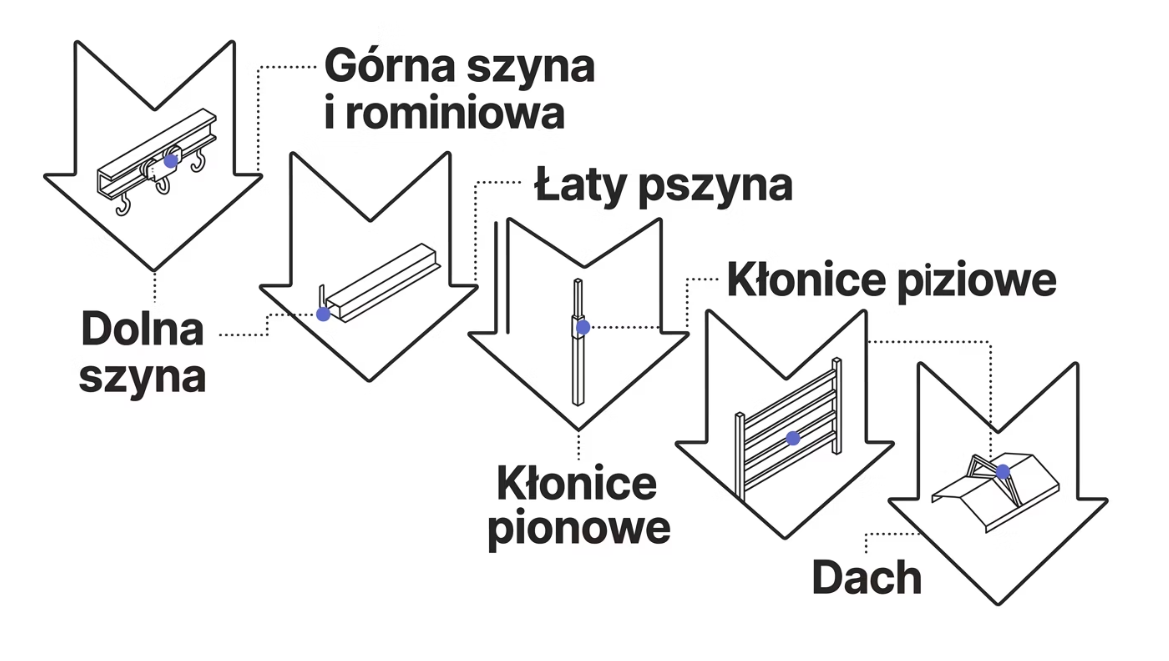
The construction of the side wall in the curtain trailer includes the following components:
- Upper aluminum rail (ceiling beam) running along the entire length of the trailer with hooks or rolling cars
- Bottom rail (side edge) with a height of 2-3 cm to prevent lateral movement of pallets during turns
- Vertical stanchions made of steel or aluminum, in versions with a lift roof extendable for free cart entry
- Aluminum horizontal battens between stanchions to create additional protection against falling loads
- Fixed or raised tilt roof used for very high loads
The curtainsider trailer in the curtain vs. tarp comparison offers access to the cargo from three sides. From the rear through a standard bi-fold or roll-up tailgate, identical to any tarp trailer. From the side by sliding the entire tarp down in seconds, opening the entire side space without removing structural components. From the top after lifting the roof on models with a tilting roof, used for very high loads requiring vertical loading.
Manufacturers of curtain-type trailers include Wielton with its NS3K models and other variants, Schmitz Cargobull, Krone, Kogel and Schwarzmüller.
Classic tarpaulin trailer
The key structural difference in the curtain vs. tarp combo relates to the side panels. A classic tarpaulin trailer has rigid or semi-rigid side members in the form of wooden siding, aluminum sections or fixed aluminum sides. The tarp covers the structure from the top and is tied down with straps along the sides; it does not slide on rails as in curtains.
The opening methods in the curtain vs tarpaulin comparison differ significantly in terms of time consumption. A classic tarpaulin trailer opens from the rear through the tailgate, which is standard and fastest, identical to curtains. Access from the top or side requires untying the side straps and lifting or folding the tarp, which takes the driver several to several minutes of manual work, while a curtain opens in seconds.
The variants of the classic curtain vs tarpaulin differ in the design of the lateral supporting elements:
- Box and tarpaulin with wooden sides best for long loads like pipes, rods, wood
- With aluminum profiled sides lighter, more frequent in bulk material handling
- Tarpaulin without sides with frame and cover alone offering maximum flexibility of dimensions
- Variants with reinforced side slats for transporting heavy construction materials
The advantage of the classic tarp in the curtain vs tarpaulin comparison is that the sides are more resistant to mechanical damage. The lack of guides and side tarpaulins eliminates the risk of being punctured by forks of a forklift, making this type better for machine-loaded cargo from the top. The classic tarp works well for loading with a crane, crane or tipping from another vehicle.
Dimensions and payload
Standard interior dimensions are identical for both types in the curtain vs. tarpaulin combination. The length of the cargo space is 13.6 meters with a maximum length of the entire combination with a tractor of 16.5 meters. Internal width is 2.45-2.48 meters with a maximum external vehicle width of 2.55 meters in accordance with Directive 96/53/EC on maximum vehicle dimensions.
| Paramount | Curtain standard | Classic curtain | MEGA curtain |
|---|---|---|---|
| Internal length | 13,6 m | 13,6 m | 13,6 m |
| Internal width | 2,45-2,48 m | 2,45-2,48 m | 2,45-2,48 m |
| Internal height | 2,70-2,75 m | 2,70-2,75 m | 3,00 m |
| Cargo capacity | ~90 m³ | ~90 m³ | ~100 m³ |
| Unladen weight of semi-trailer | 7,0-8,5 t | 6,5-8,0 t | 7,5-9,0 t |
| Net payload (at 40t GVW) | 24-25 t | 24-25 t | 23-25 t |
| Number of europallets (120×80 cm) | 33-34 pcs. | 33-34 pcs. | 33-34 pcs. |
The tare weight in the curtain vs. tarpaulin combination differs slightly. A curtain semi-trailer weighs between 7.0 and 8.5 tons because of the rails, stanchions and side tarpaulin. A classic tarpaulin semi-trailer weighs from 6.5 to 8.0 tons, depending on the design of the sides. In practice, with a permissible gross combination weight of 40 tons and a tractor weight of about 8 tons, the net payload is 24-25 tons for both variants in the curtain vs. tarpaulin comparison.
The MEGA trailer is a higher variant in the curtain vs standard tarp comparison. The internal height of 3 meters gives a capacity of about 100 cubic meters compared to 90 cubic meters for the standard version. The MEGA is ideal for lightweight, voluminous goods such as textiles, boxed electronics and foam. The number of pallets remains the same in the curtain vs. tarp MEGA combination, but the height of the products transported can be higher.
Loading and unloading
Practical differences in loading speed and convenience are a major decision factor in choosing curtain vs. tarpaulin. A curtainsider trailer offers advantages for side loading with a forklift, where the tarp is pushed back in seconds and the forklift enters perpendicularly from the side. You don’t have to stack pallets sequentially deep into the trailer; you can load the entire width at once.
Advantages of curtain vs. tarpaulin when loading:
- Side loading by forklift without stacking pallets sequentially deep into the trailer
- Ability to load the entire width simultaneously from both sides of the vehicle
- Multi-point loading with access to selected pallets without unloading the whole thing
- Cross-docking in distribution centers with side docks built into the infrastructure
- Loading time for 33 pallets about 45-90 minutes versus 60-120 minutes for tarpaulin from the rear
- Eliminate the risk of cargo damage when driving deep into a trailer through a narrow aisle

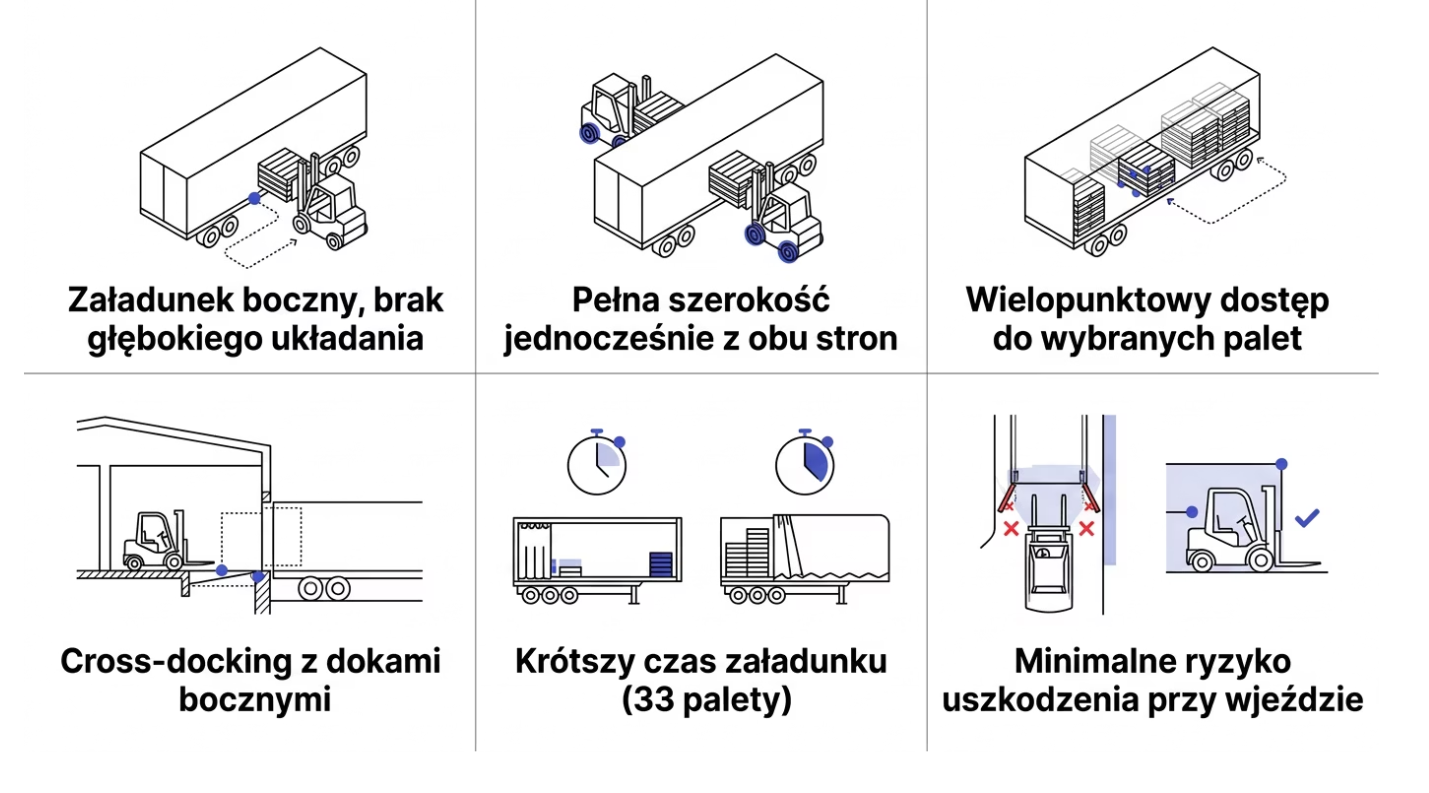
Multi-point loading is another advantage in the curtain vs tarp comparison. For multi-customer deliveries, only a selected part of the side wall can be opened and a specific pallet can be accessed without unloading the whole thing. Cross-docking in distribution centers prefers the curtain wall trailer as standard, since loading terminals have side docks built into the warehouse infrastructure.
When is a classic tarpaulin trailer better? LIFO (last in, first out) loads from one shipper to one consignee carried from the rear do not require side access. Cargoes poured in from the top like aggregates, grain or wood prefer a classic tarp with an open top. Long loads stacked lengthwise like pipes, rods or beams also do not benefit from side access, so a tarpaulin trailer performs better in such applications.
Loading with a crane or crane from the top is the domain of the classic tarp in the curtain vs. tarp comparison. A tarp with a fully retractable roof or roll roof is superior to a curtain with a fixed roof. Transporting steel in coils, coils or sheets requires vertical access, where the classic tarp has a clear structural advantage.
What loads for a curtain and what loads for a tarp?
The choice in the curtain vs. tarpaulin depends primarily on the type of goods being transported and how they are loaded. A curtainsider trailer is ideal for Euro pallets of FMCG goods, dry groceries, beverages, consumer electronics and white goods. Deliveries to supermarket chains and distribution centers require side access to docks, making the curtainsider virtually the only option in this segment.
Curtain trailer applications:
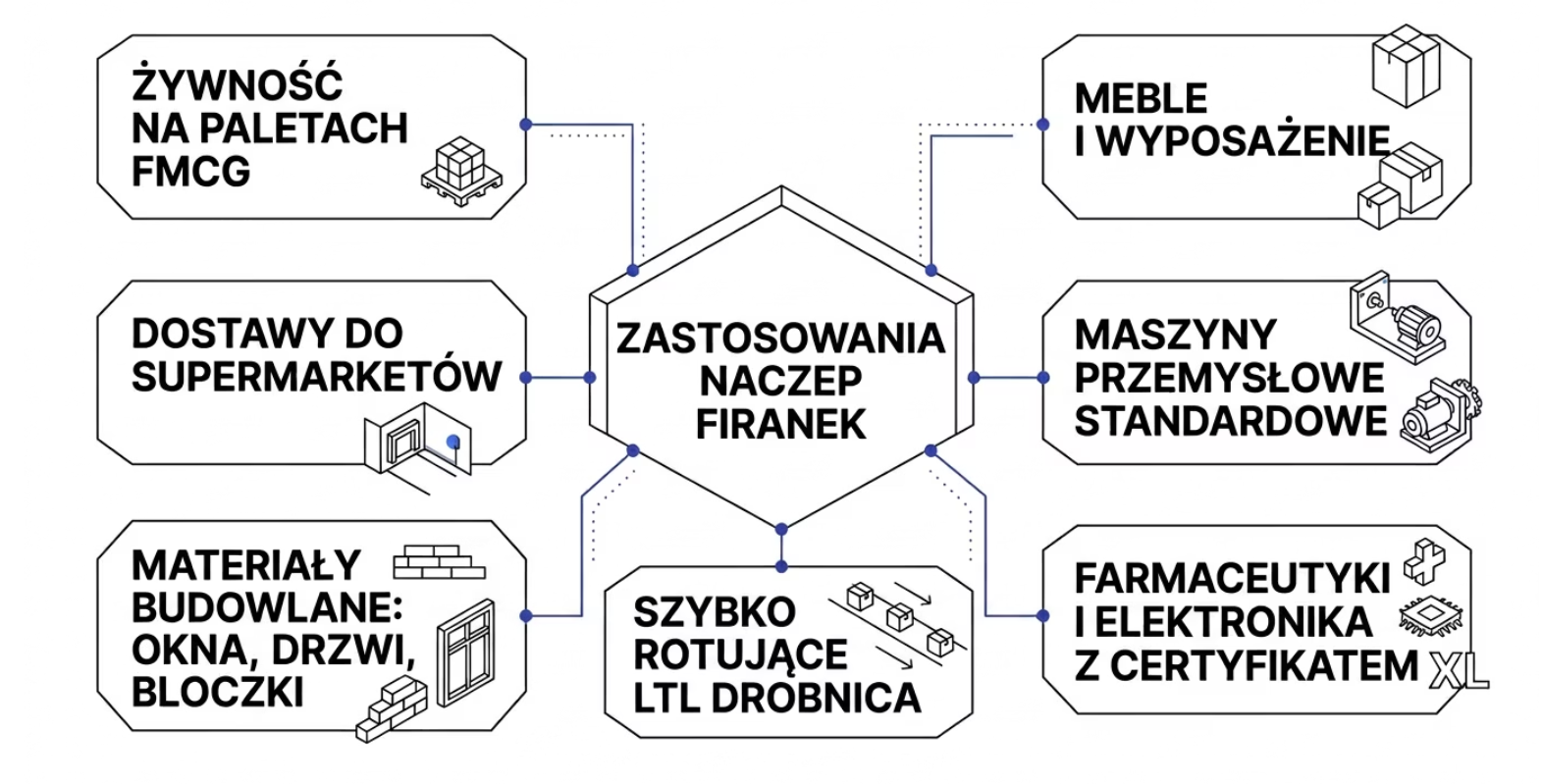
- Euro pallets of FMCG goods, dry groceries, beverages, snacks
- Deliveries to supermarket chains, hypermarkets and distribution centers with side docks
- Palletized building materials such as ceramics, bricks, blocks, windows, doors
- Furniture and home furnishings, non-height, pre-packaged cardboard items
- Industrial machinery and equipment with standard dimensions on euro pallets
- Pharmaceutical products and electronics in XL-certified versions
- Fast-moving goods with multiple pick-up points in LTL general cargo system
Palletized building materials in a curtain vs. tarpaulin combination prefer curtain because of the convenience of loading. Ceramics, bricks, blocks, windows and doors are typically loaded by side forklift. Furniture and furnishings, machinery and industrial equipment with standard dimensions also benefit from the side loading flexibility offered by the curtainsider trailer.
Applications of the classic tarpaulin trailer:
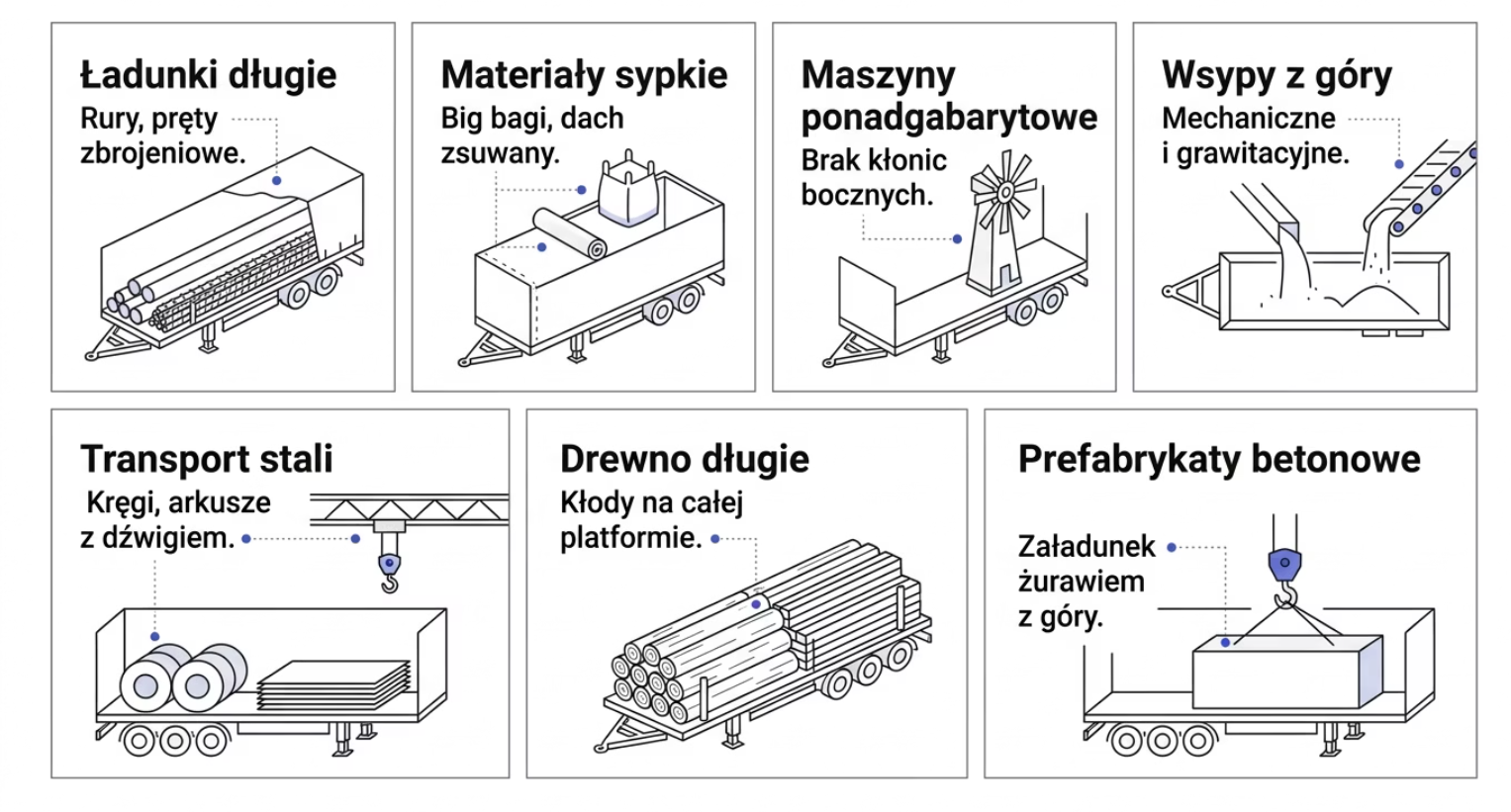
- Long loads: steel pipes, rebar, wooden beams stacked along the trailer
- Bulk materials in big bags or mesh pallets loaded from the top through the sliding roof
- Machinery and equipment oversized in height benefiting from the absence of side stanchions
- Loads loaded mechanically from the top through a dump truck, conveyor belt or gravity chute
- Transport of steel in coils, coils, sheets loaded by crane or overhead crane from above
- Long timber, logs, rafters, lumber stacked across the platform
- Precast concrete elements requiring crane loading from above
The classic curtain vs. tarpaulin semi-trailer works better for long loads. Steel pipes, rebar, wooden beams, rafters and steel angles stacked lengthwise require loading through the siding or from the front after removing the top tarp. Bulk materials in big bags loaded from the top through the sliding roof are the domain of the classic tarp, where the curtain has structural limitations.
XL certificate, a curtain for sensitive cargoes
XL certification according to EN 12642 Code XL is a European standard for safety and durability of trailer bodies issued by independent bodies such as DEKRA, Bureau Veritas and TÜV. In the curtain vs. tarp comparison, the XL certificate is much more common in curtain trailers due to the design of the side walls and the possibility of effective sealing.
XL requirements for curtainsider trailers in the curtain vs standard tarp comparison include the side wall’s ability to withstand cargo forces at least 0.4 times the total cargo weight. The front wall must withstand at least 0.5 times the weight of the load, the rear wall 0.3 times, and the roof 0.6 kilonewtons per square meter. The XL-certified curtainsider trailer has special duck locks, T-Lock customs seals and GPS monitoring with side wall opening sensors.
Additional security features on XL trailers:
- Special duck locks to prevent opening without visible signs of break-in
- T-Lock customs seals or equivalent with serial numbering and registration in the system
- GPS monitoring with real-time side wall and rear door opening sensors
- Possibility of sealing after loading with confirmation of transport integrity
- Reinforced load securing points with increased strength of transport straps
Pharmaceutical companies adhering to GDP (Good Distribution Practice), electronics manufacturers, the tobacco industry, perfumers and liquor manufacturers in the curtain vs. tarp comparison require XL certification in shipping contracts or as an insurer requirement. An XL-certified trailer costs about 5-15 percent more than standard, but the freight rate can be 10-20 percent higher, making the investment worthwhile for carriers specializing in these industries in the curtain vs. tarpaulin premium segment.
Purchase and maintenance costs
The cost of buying new trailers in the comparison shows differences of 5-15 percent in favor of the classic tarpaulin. A standard classic tarpaulin trailer costs between 60,000 and 90,000 euros. A standard curtain semi-trailer requires a budget of 70,000 to 100,000 euros due to more expensive rails, stanchions and a side tarp with a sliding mechanism.
| Type of trailer | Purchase price (new) | Cost of tarpaulin replacement |
|---|---|---|
| Classic tarpaulin standard | 60 000 – 90 000 EUR | 2 000 – 5 000 EUR |
| Curtain standard | 70 000 – 100 000 EUR | 3 000 – 8 000 EUR |
| MEGA curtain (3 m high) | 80 000 – 110 000 EUR | 3,500 – 9,000 EUR |
| XL certified curtain | 75 000 – 115 000 EUR | 3,500 – 9,000 EUR |
Maintenance differs mainly in the cost of replacing the side tarp. A curtainside trailer requires replacement of the complete tarp after 5-7 years of intensive use, costing between €3,000 and €8,000. The rails and stanchions require service every 6-12 months, and failures, while rare, can be costly. Damaged stanchions are an expense of €500 to €2,000 per component in the curtain vs. tarp comparison in terms of repair costs.
The classic curtain semi-trailer has a cheaper replacement of the top tarp due to a smaller area or simpler material without sliding mechanisms. The difference in tare weight between curtainsider (7.0-8.5 tons) and tarpaulin (6.5-8.0 tons) is at most 0.5-1 ton, which translates into a slightly higher payload for tarpaulin. In practice, at a GVW of 40 tons, the difference is marginal for most loads in the curtain vs. tarpaulin comparison.
The freight rate is usually similar because both types are common and there is no surcharge for the type of trailer in standard transportation. Exceptions are specialized variants like curtain XL, curtain MEGA or refrigerated curtain, which generate higher rates due to specialization and additional equipment in the curtain vs premium tarpaulin segment.
Which type to choose? Decision scheme curtain vs tarpaulin
The decision should be based on an analysis of the vehicle’s main uses. The following table provides specific recommendations for different transportation scenarios, helping you make the optimal business decision in choosing curtain vs. tarpaulin.
| Situation / Cargo type | Curtain | Classic tarpaulin |
|---|---|---|
| Euro pallets, FMCG goods | Strongly recommended | Suboptimal |
| Network deliveries with side dock | Required | Impossible |
| Long loads: pipes, beams over 6 m | Suboptimal | Strongly recommended |
| Crane loading from above | Limited (no roof lift) | Better |
| Transport of pharmaceuticals/electronics | Recommended (curtain XL) | Difficult certification |
| Bulk cargo poured in from above | Suboptimal | Standard |
| One sender to one recipient | Both options OK | Both options OK |
| Furniture, household appliances, standard machines | More convenient | Also works |
| Cross-docking, multi-point reception | Required | Ineffective |
| Transport of steel in coils, coils | Limited | Definitely better |
The golden rule in selection is based on an analysis of your main customers and loads. If most of your customers have side docks or you accept cross-dock loads, choose a curtain-sided trailer. If the loads are long or poured in from the top, a classic tarpaulin trailer will be better. If you’re not sure what you’ll be hauling in the future, go for a curtainsider, which is more flexible and dominates the general transportation market in the curtain vs. tarpaulin comparison.
For carriers planning to purchase their first semi-trailer, a curtainsider is recommended due to its wider use and larger market for orders. For companies specializing in transporting long building materials, steel or timber, a classic tarpaulin trailer will be more cost-effective and functional. The decision curtain vs tarpaulin should take into account the long-term development strategy of the transport company.
Curtain vs tarpaulin in practice
The comparison shows that there is no unequivocally better universal choice for any carrier. The curtainsider trailer dominates pallet, FMCG, electronics and distribution center deliveries because of the speed and convenience of side loading. The classic tarpaulin trailer remains indispensable for long, top-loading and oversized cargo in terms of height in the curtain vs. tarpaulin comparison.
The difference in purchase cost is 5-15 percent in favor of the curtainsider, but the higher versatility of the curtainsider often makes up for this difference by accessing a wider market for orders. For most start-up carriers, a curtainsider trailer is the safer choice for operational flexibility in the curtain vs. tarpaulin comparison in terms of available orders.
Specialization in a particular segment may justify the choice of a classic tarpaulin in a curtain vs tarpaulin comparison. Companies involved in transporting steel, long timber, construction materials or aggregate will find the classic tarpaulin the optimal working tool. The key is to analyze major orders and customer requirements before making an investment decision in the curtain vs tarpaulin dilemma.
Find the right trailer for your cargo
Are you looking for a curtainsider trailer for euro pallets, a classic tarpaulin for steel tubes or a MEGA for voluminous textiles? The choice between curtain vs. tarpaulin depends on the specifics of your transports. Antrans BiS connects shippers with carriers with different types of trailers tailored to specific logistics needs in the curtain vs tarpaulin segment.
Whether you need an XL-certified curtainsider for pharmaceuticals or a tarp for loading long bales from above, you’ll find the right carrier with the right equipment. Contact us and find out how simple it is to match the type of trailer to the characteristics of your loads in a curtain vs. tarpaulin analysis for your transport company.
Useful articles: How to open a transport company in Poland in 8 steps | Obtaining transport orders. 5 effective ways for new transports | Subsidies for road transport. Subsidies for transport | Transport documents in road transport in 2026.
FAQ – The most common questions about curtain vs tarpaulin
Below you will find specific answers to your most important questions about the differences between curtainsiders and classic tarps. We’ll explain the construction, applications, costs and purchasing decisions that will help you understand which type of trailer will be optimal for your transportation needs.
Are curtain and tarp the same thing?
Curtain vs. tarpaulin is a comparison of two subtypes of tarpaulin trailers, not two completely different categories of vehicles. Both have a PVC cover on a rigid frame, but differ in their cargo access mechanism. The curtain semi-trailer opens laterally on rails like a curtain, where the tarp slides open in seconds without removing the components. A classic curtain semi-trailer requires untying and lifting the cover from the top or side, which takes the driver several to several minutes. Common elements in the curtain vs. tarpaulin combination are the floor, frame, headboard, bogies and cargo securing points. The design differences are only in the way the sides are attached and opened. Curtain vs. tarpaulin is a choice between the speed of side loading and the ability to transport long and top-loaded cargo.
How many pallets does a curtainsider trailer hold and is it different from a tarp?
The standard curtain and tarpaulin semi-trailer hold an identical number of pallets: 33-34 EURO pallets (120×80 cm) or 26-27 industrial pallets (120×100 cm). The interior dimensions in the curtain vs. tarpaulin comparison are the same – 13.6 meters long and 2.45-2.48 meters wide. The MEGA trailer in both curtain and tarpaulin versions has the same number of pallets on the floor, but a higher interior height of 3 meters versus 2.70-2.75 meters in the standard version. The volume capacity of curtain vs. tarpaulin is about 90 cubic meters for the standard version and about 100 cubic meters for the MEGA. The difference between curtain vs. tarpaulin is not in the number of pallets, but in the way they are loaded and unloaded. The curtain allows all pallets to be loaded sideways in 45-90 minutes, while a tarpaulin loaded backwards requires 60-120 minutes for the same 33 pallets.
What is the payload capacity of a curtainsider trailer and is it different from a classic curtainsider?
The net payload in the curtain vs. tarpaulin comparison is about 24-25 tons with a GVW of 40 tons of kit, a tractor weight of about 8 tons and a trailer weight of 7-8.5 tons. The curtain semi-trailer weighs from 7.0 to 8.5 tons due to the rails, stanchions and sliding mechanism of the side tarpaulin. A classic tarpaulin semi-trailer weighs from 6.5 to 8.0 tons, depending on the design of the side boards. The difference in tare weight between curtain vs tarpaulin is at most 0.5-1 ton, which translates into a slight advantage for tarpaulin in payload capacity. In practice, with standard pallet loads, this difference is marginal and does not affect the business decision. Curtain vs. tarpaulin in terms of payload capacity are practically equivalent, so the choice should be based on other criteria such as cargo type and loading method.
Is a curtain more expensive to purchase than a classic tarp?
Yes, a curtain trailer is more expensive by about 5-15 percent compared to curtain vs classic tarp. A new standard classic tarp costs between 60,000 and 90,000 euros, while a new standard curtain requires a budget of 70,000 to 100,000 euros. The difference is due to more expensive components such as aluminum rails, extendable stanchions, a sliding mechanism and a larger side tarp area. A MEGA curtainsider with an interior height of 3 meters costs between 80,000 and 110,000 euros. An XL-certified curtain trailer requires an investment of 75,000 to 115,000 euros, another 5-15 percent more than a standard curtain. Maintenance costs in the curtain vs. tarp comparison are also higher for the curtain – replacing a complete side tarp after 5-7 years costs from 3,000 to 8,000 euros, while a classic tarp requires 2,000 to 5,000 euros.
What is a MEGA trailer and does it apply only to curtain or tarpaulin?
The MEGA trailer is a variant of both curtain and classic tarp with an interior height of 3 meters instead of the standard 2.70-2.75 meters. A comparison of curtain vs. tarpaulin versions of the MEGA shows that both types can be produced in this higher variety. The volumetric capacity of the MEGA is about 100 cubic meters versus about 90 cubic meters for the standard version, which gives about 10-11 percent more space. The MEGA is ideal for lightweight, volumetric goods such as textiles, paper goods, consumer electronics in large cartons or foam. The length and width of the curtain vs. tarp MEGA remain identical – 13.6 meters long and 2.45-2.48 meters wide. The number of pallets on the floor is still 33-34 EURO pallets, but the height of the transported products can be higher by about 25-30 centimeters compared to the standard version.
Does a curtain protect cargo from rain as well as a classic tarp?
Yes, the 600-900 gsm PVC side tarp in the curtain trailer is waterproof and protects the cargo identically to the classic tarp. The material in the curtain vs tarpaulin comparison is the same and meets the ISO 1421 standard for UV and tear-resistant technical covering materials. The difference may relate to tightness in strong crosswinds – a classic tarp is usually more tightly strapped with straps along the sides, while a curtain can have more slack with leaking closures of the lower rails. In practice, modern curtain trailers have rubber seals in the lower rail that eliminate this problem. Curtain vs. tarp in terms of protection from precipitation are equivalent with proper maintenance and efficient closing mechanisms. XL certification requires additional sealing standards, making the curtain XL even more weatherproof for transporting sensitive pharmaceutical or electronic cargo.

Dyrektor Generalny | Antrans BiS, OlkuszSebastian Szklarczyk od ponad 15 lat kieruje rozwojem Antrans BiS – firmy transportowej realizującej przewozy w całej Europie. Zaczynał jako Kierownik Działu Spedycji, gdzie zdobywał praktyczne doświadczenie w organizacji przewozów międzynarodowych i zarządzaniu flotą pojazdów na trasach europejskich.
Jako Dyrektor Generalny odpowiada za strategiczne zarządzanie firmą realizującą rocznie ponad 21 000 transportów na kluczowych kierunkach: Polska-Włochy, Polska-Niemcy, Polska-Austria, Hiszpania, Benelux i Skandynawia. Pod jego kierownictwem Antrans BiS rozwinął flotę do 220 pojazdów (własnych i partnerskich) oraz osiągnął terminowość dostaw na poziomie 98%.
Specjalizacja: transport międzynarodowy FTL w całej Europie, logistyka automotive i FMCG, optymalizacja tras europejskich, przepisy drogowe i zakazy ruchu w UE, dokumentacja przewozowa (CMR, VAT-UE, INTRASTAT).
Na blogu Antrans BiS dzieli się praktyczną wiedzą z zakresu spedycji międzynarodowej, przepisów transportowych oraz biznesowych aspektów prowadzenia firmy TSL w różnych krajach europejskich.
Kontakt:
sebastian.szklarczyk@antransbis.pl
Szukasz stałego partnera logistycznego?
Zostaw kontakt - Zadzwonimy!