


How much can the cargo stick out from the back of the truck?
The cargo at the rear of the vehicle may protrude a maximum of 2 meters from the rear plane of the contour of the vehicle or vehicle combination. The only exception is long timber carried on a stanchion trailer, which can extend up to 5 meters behind the axle of the trailer. These limits apply to all vehicles in accordance with Article 61 of the Road Traffic Law of June 20, 1997.
Regulations on how much cargo can protrude from the rear of a car are identical for passenger vehicles, vans and trucks. In practice, however, trucks most often carry loads that exceed the vehicle’s outline, such as steel pipes, wooden beams, construction machinery, structural components or long timber. Drivers and cargo dispatchers must know the exact regulations to avoid fines and administrative penalties.
In this article, we will explain in detail how much cargo can protrude from the rear of a car in various configurations, how to properly measure protrusion, when labeling is required, the penalties for exceeding limits, and how to legally transport indivisible cargo requiring special permits.
Basic rule – 2 meters maximum
The limit for how much cargo can protrude from the rear of a car is exactly 2 meters measured from the rear plane of the contour of the vehicle or combination of vehicles. This is a fundamental principle enshrined in Article 61(6) of the Traffic Law, which applies without exception to divisible cargo.
The measurement is taken from the rear contour of the entire vehicle. The rear load of a tractor-plus-trailer combination is measured from the rear edge of the trailer, not from the cab or the center of the vehicle. A standard semi-trailer is 13.6 meters long, which means that items up to 15.6 meters long fall within the two-meter limit.
| Type of cargo | Overall length | Overhang | Legal status |
|---|---|---|---|
| Steel pipes on a trailer 13.6 m | 14 m | 0,4 m | OK, without marking |
| Steel pipes on a trailer 13.6 m | 15 m | 1,4 m | OK, requires marking |
| Wooden beams on a trailer 13.6 m | 15,6 m | 2,0 m | OK, requires marking |
| Wooden beams on a trailer 13.6 m | 16 m | 2,4 m | TRANSFER – permit |
A key distinction concerns the divisibility of cargo. The 2-meter limit on how much a load can protrude from the rear of a car applies to divisible loads. A finished roof truss, a complete machine or a turbine component are indivisible loads that can exceed the limit with the appropriate permit.
Attention carriers! Loading in the back of a car in excess of 2 meters without the proper authorization will result in an administrative fine of 6,000 to 15,000 zlotys imposed by ITD. Both the carrier and the shipper are liable.
From what to measure properly?
The correct measurement of how much cargo can protrude from the rear of a car is questionable. The rear contour plane is a perpendicular plane through the most protruding parts of the rear of the vehicle.
Typical errors in measurement include:
- Counting from the rear axle instead of the rear wall of the vehicle (error by up to half a meter)
- Measure from the edge of an empty box instead of from a closed door or sideboard
- Skipping the boom of hooks or rubber bumpers (that’s also the outline of the vehicle)
- Measuring from the theoretical center of the vehicle instead of the actual rear end
A special exception applies for a stanchion trailer. The rear cargo of long timber can extend up to 5 meters behind the axle of the trailer, not behind its rear outline. This is an important difference that allows long logs to be transported.
Always measure from the rear bumper or box closure hooks. An error of 10-20 centimeters can determine a fine during an inspection.
Load dimensions in other directions
Although the focus is on how much cargo can protrude from the rear of the car, drivers also need to know the limits for other dimensions. The following rules complete the picture of complete legal requirements.
| Direction | Maximum limit | Marking |
|---|---|---|
| Rear | 2,0 m | Above 0.5 m: red and white stripes |
| Front | 0,5 m | Orange flag |
| Side | 2.55 m (3.0 m with load) | Orange pennant |
| Top | 4.0 m total | Not applicable |
The maximum total width of the vehicle is 2.55 meters. The cargo at the rear of the vehicle can also protrude laterally a maximum of 23 centimeters on each side, giving a total width of up to 3 meters. The overall height is 4 meters, which requires route planning that takes into account overpasses and parking lots.
When is labeling required?
The threshold for mandatory marking is 0.5 meters. Cargo in the rear of the car protruding above this limit requires proper labeling, and failure to do so will result in a fine of 200 to 500 zlotys.
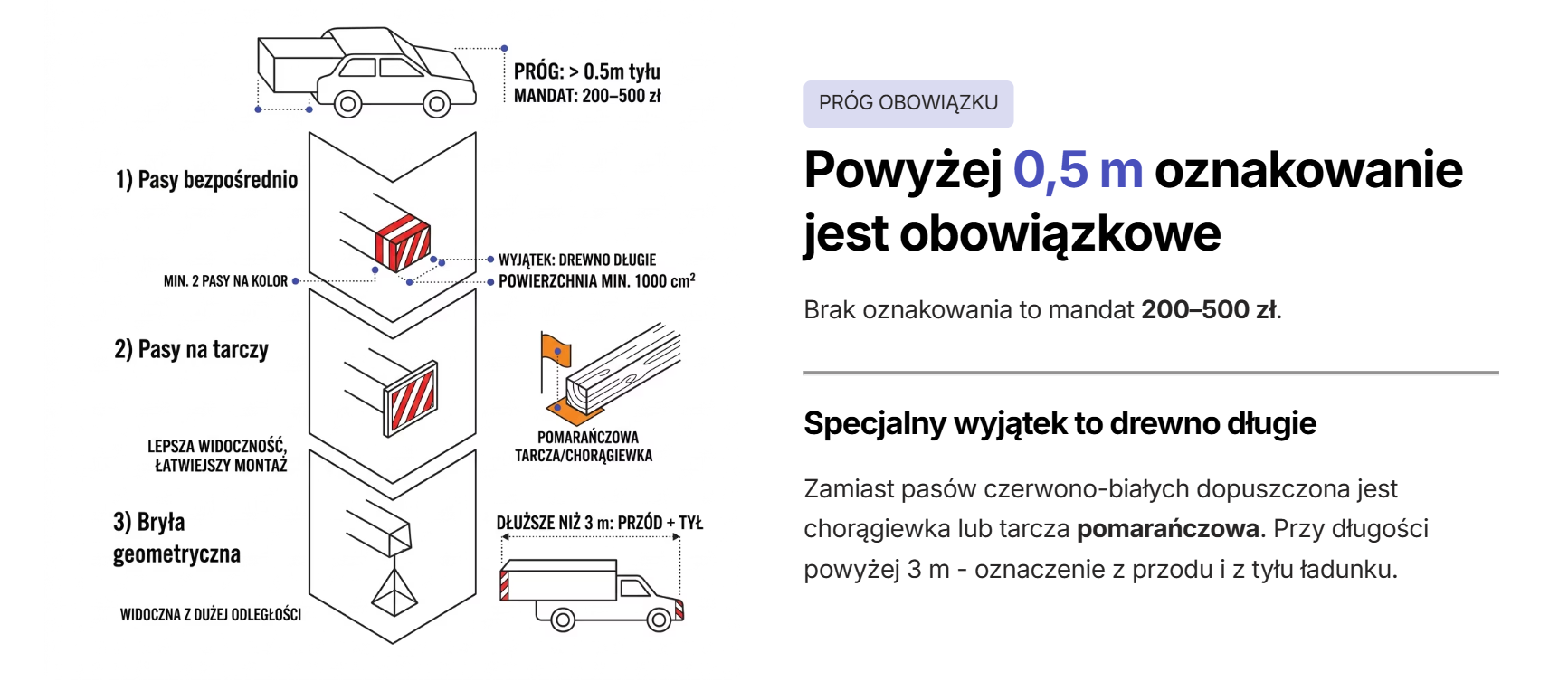
The regulations allow three alternative methods of labeling:
1. Red and white stripes directly on the cargo
A minimum of two stripes of each color (2 red + 2 white) with a total area of at least 1000 cm² as seen from the rear. The cargo at the rear of the car can be painted directly or wrapped with reflective stripes.
2. Straps on a disc attached to the load
Red and white stripes on a rigid shield attached to the rear face of the load. Cargo at the rear of the car marked in this way is more visible and easier to install than painting.
3. Geometric solid suspended at the end of the
A red and white cone or pyramid suspended from the most protruding point. The cargo at the rear of the car in this configuration is clearly visible from a distance.
Illumination at night and with limited visibility
Belts alone are not sufficient in low visibility conditions. Cargo at the rear of the car protruding at night, in fog or during precipitation requires additional lighting according to the following rules:
- Red light at the rear end of the load
- Red reflector not more than 40 cm from the edge
- White reflector on the front (if the load also protrudes from the front)
- Approved lighting, not ordinary bicycle lights
Lack of lighting by the load at the rear of the car at night is an additional fine of 200 to 500 zlotys. In total, you can receive a fine of up to 1,000 zlotys for lack of signage and no lights at the same time.
Transportation of indivisible cargo
Cargo in the back of a car exceeding 2 meters can be legally transported only if it meets the definition of indivisible cargo. Article 64 of the Traffic Law defines it as cargo that cannot be divided into smaller parts without disproportionate cost or risk of damage.
Examples of indivisible cargoes
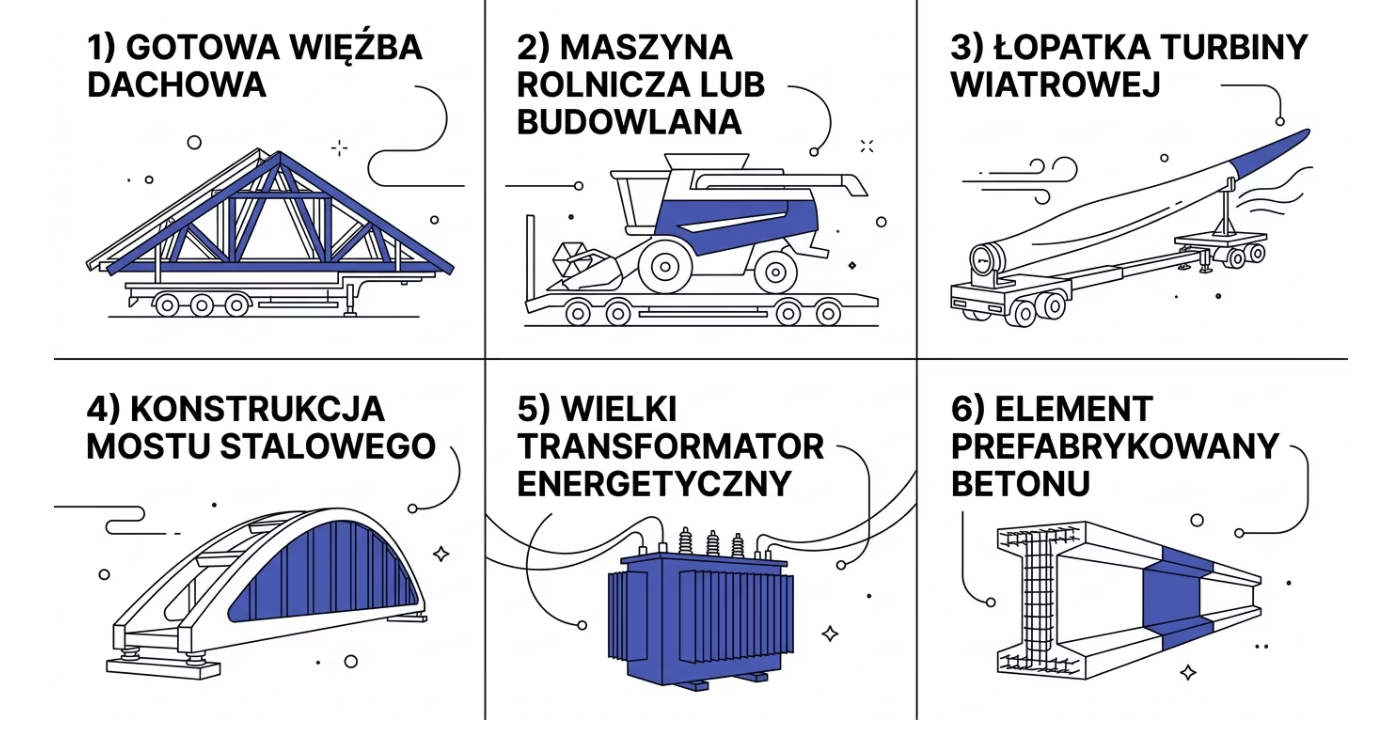
- Finished roof trusses as a complete structure
- Agricultural or construction machinery as a whole
- Wind turbine blade
- Steel bridge construction
- Large energy transformer
- Precast concrete element
Absolute prohibition: an abnormal vehicle is not allowed to carry divisible cargo. Cargo in the back of the vehicle in the form of beams, which can be divided into smaller batches, must be within the limit of 2 meters. Carrying divisible cargo with an abnormal permit will result in heavy fines.
| Permit category | Scope | Authority |
|---|---|---|
| I | Slow-moving vehicles, agricultural tractors | Starost |
| II-IV | Exceeding standard dimensions | District Governor / GDDKiA |
| V | Exceptional cases | GDDKiA / President |
Requirements in abnormal transport

- Pilotage when width exceeds 3 m or length 20 m
- Speed limit in accordance with the permit category
- Planned and approved route of travel
- Notice of the road manager at bridges and overpasses
- Proper security and marking of cargo
Fines for irregularities
The fine for failing to mark the cargo on the back of the car is between 200 and 500 zlotys. This is a fine imposed by the Police or ITD during a roadside inspection. Lack of night lights is another 200-500 zloty fine.
| Violation | Penalty | Authority |
|---|---|---|
| Lack of marking | 200-500 PLN | Police, ITD |
| No night lights | 200-500 zloty | Police, ITD |
| Exceeded by ≤10% | PLN 6,000 | ITD |
| Exceeded by 10-20% | PLN 10,000 | ITD |
| Exceeded by >20% | up to 15 000 zł | ITD |
The administrative penalty is much harsher. Cargo in the back of a car exceeding the 2-meter limit without a permit will result in a fine of 6,000 to 15,000 zlotys, depending on the scale of the excess. The carrier, shipper and transport organizer are liable.
Additional implications:
- Stopping the vehicle pending reloading or obtaining a permit
- Delivery delay and additional downtime costs
- Revocation of license with gross or repeated violations
- Criminal liability when causing a traffic hazard
Securing the long load
Article 61(1) of the Traffic Law imposes an obligation to secure the cargo. The cargo in the rear of the car must be immobilized so that it cannot change position, fall out of the vehicle, obstruct the lights or limit the driver’s visibility.

Methods of securing long loads:
Approved transport belts
An essential tool for long loads. Rear cargo requires belts with LC (Load Capacity) parameters appropriate to the weight. Do not use worn or cut belts.
Chains with tensioners
For metal loads with sharp edges. Cargo at the rear of the car in the form of steel pipes or profiles requires cut-resistant chains.
Supports and wedging
Prevents sliding along the axle of the vehicle. The cargo at the rear of the car cannot swing while driving, braking or cornering.
Proper weight distribution
A long load heavier than the rear lifts the front of the vehicle. Cargo at the rear of the car requires redistribution of weight closer to the center of gravity for safe driving.
Responsibility of the driver
Cargo in the rear of the car remains the responsibility of the driver even if loaded by the shipper. Before setting off, the driver must check for proper placement, securing and marking. In case of an accident caused by loss of cargo, the driver is responsible.
Find transportation for non-standard loads
Do you need to transport cargo in the back of your vehicle that exceeds standard dimensions? Long loads such as pipes, beams, planks, machinery or structural components require specialized vehicles. The Antrans BiS platform connects shippers with carriers with platforms, trailers, stanchion trailers and telescopic trailers.
Whether your rear-end cargo fits within the 2-meter limit or requires an abnormal permit, you’ll find the right carrier with experience in specialized transportation. Contact us and find out how simple it is to arrange professional transportation of long loads with full documentation service.
Useful articles: How to open a transport company in Poland in 8 steps | Obtaining transport orders. 5 effective ways for new transports | Subsidies for road transport. Subsidies for transport | Transport documents in road transport in 2026.
FAQ – The most common questions about cargo in the back of a car
Below you will find specific answers to your most important questions about the regulations governing the display of cargo at the rear of a vehicle. We will explain the exact limits, marking rules, penalty amounts and exceptions for indivisible loads and long timber. This is a practical compendium before loading unusual loads on a truck, trailer or semi-trailer.
Exactly how much cargo can protrude from the back of a truck?
Cargo at the rear of a vehicle may protrude a maximum of 2 meters from the rear plane of the contour of the vehicle or combination of vehicles, according to Article 61(6) of the Traffic Law. This limit applies to all vehicles regardless of type – cars, vans and trucks. The only exception is long timber transported on a stanchion trailer, where the load at the rear of the car can extend up to 5 meters behind the axle of the trailer, not behind its rear contour. The measurement is always taken from the rearmost part of the vehicle, such as the bumper, box locking hooks or the rear edge of the trailer. For a standard 13.6-meter-long trailer, this means that pipes or beams up to 15.6 meters long are within the legal limit. Rear cargo in excess of 2 meters requires an abnormal transport permit and can only apply to undivided cargo.
Does a load sticking out the back by 0.5 meters require marking?
No, the cargo at the rear of the car protruding exactly 0.5 meters or less does not require any marking. The obligation to mark only arises when the protrusion exceeds 0.5 meters from the rear contour of the vehicle. A load at the rear of the vehicle protruding 0.6 meters, for example, must already be marked with red and white stripes or an orange flag in the case of long timber. This is a threshold to remember, as failure to mark when projecting more than 0.5 meters will result in a fine of 200 to 500 zlotys. The regulations provide for three permissible marking methods: red and white stripes directly on the load, stripes on a shield attached to the load, or a red and white geometric lump suspended from the end of the load. The cargo at the rear of the car in the form of long timber may be marked with an orange flag instead of red and white stripes.
What is the penalty for failing to mark a load protruding from the rear of a car?
The fine for failing to mark the cargo on the back of the car is between 200 and 500 zlotys and can be imposed by the Police or the Road Transport Inspection. If, in addition, there is a lack of night lighting at the protruding load, you face another fine of 200 to 500 zlotys. A load in the back of a car exceeding the 2-meter limit without a proper abnormal vehicle permit results in a much more severe administrative penalty imposed by ITD. Exceeding the standards by up to 10 percent is a penalty of PLN 6,000, exceeding by 10-20 percent is PLN 10,000, and exceeding by more than 20 percent can cost up to PLN 15,000. The penalty falls on the carrier, the shipper and the transport organizer. Loading in the back of a car in violation of the regulations can also result in the ITD stopping the vehicle until reloading or obtaining the proper permit, causing delays and additional costs.
Can a tractor with a 13.6-meter semi-trailer carry 15-meter-long pipes?
Yes, the cargo at the back of the car in the form of 15-meter-long pipes can be carried on a 13.6-meter trailer, as the overhang is 1.4 meters and within the 2-meter limit. Pipes 15 meters long loaded on a standard semi-trailer will extend exactly 1.4 meters beyond the rear edge, which is in compliance with regulations. However, the cargo at the rear of the truck in this configuration requires mandatory marking with red and white stripes, as it exceeds the 0.5 meter threshold. Pipes must also be properly secured with transport straps or chains so that they cannot change position while driving. A 16-meter-long rear load on the same semi-trailer would already protrude 2.4 meters, which exceeds the limit and requires an abnormal transport permit and classification as an indivisible load.
How do you transport a load that needs to stick out more than 2 meters in the back?
Cargo in the rear of a car exceeding the 2-meter limit may be carried only with a permit for an abnormal vehicle issued by the District Governor or the General Directorate for National Roads and Motorways. A condition of the permit is that the cargo must be indivisible in accordance with Article 64 of the Traffic Law, that is, cargo that cannot be divided into smaller parts without disproportionate cost or risk of damage. A load in the back of a car in the form of a finished roof truss, a complete agricultural machine or a wind turbine component meets this definition. There are five permit categories from I to V, depending on the scale of the exceedance of the standards. When the width exceeds 3 meters or the length exceeds 20 meters, pilotage by one or two vehicles is required. Rear-end loading in abnormal transport requires a planned route, a speed limit and notification of the road manager when crossing bridges and overpasses.
When transporting long timber, are there different regulations for the rear load?
Yes, the rear cargo of long timber carried on a stanchion trailer has a special exemption allowing it to extend up to 5 meters behind the axle of the trailer. This is significantly more than the standard 2-meter limit applicable to other loads. The measurement is taken from the axle of the stanchion trailer, not from its rear outline, which gives extra space. The rear cargo of timber can be marked with an orange flag or shield instead of the red and white stripes required for other types of cargo. If the timber load is longer than 3 meters, the pennant is placed both in front and behind the edge of the load. Rear cargo carrying timber also requires special protection with a stanchion chain to prevent logs from moving during transport. These regulations make it easier for the timber industry to transport long logs without cutting them.

Dyrektor Generalny | Antrans BiS, OlkuszSebastian Szklarczyk od ponad 15 lat kieruje rozwojem Antrans BiS – firmy transportowej realizującej przewozy w całej Europie. Zaczynał jako Kierownik Działu Spedycji, gdzie zdobywał praktyczne doświadczenie w organizacji przewozów międzynarodowych i zarządzaniu flotą pojazdów na trasach europejskich.
Jako Dyrektor Generalny odpowiada za strategiczne zarządzanie firmą realizującą rocznie ponad 21 000 transportów na kluczowych kierunkach: Polska-Włochy, Polska-Niemcy, Polska-Austria, Hiszpania, Benelux i Skandynawia. Pod jego kierownictwem Antrans BiS rozwinął flotę do 220 pojazdów (własnych i partnerskich) oraz osiągnął terminowość dostaw na poziomie 98%.
Specjalizacja: transport międzynarodowy FTL w całej Europie, logistyka automotive i FMCG, optymalizacja tras europejskich, przepisy drogowe i zakazy ruchu w UE, dokumentacja przewozowa (CMR, VAT-UE, INTRASTAT).
Na blogu Antrans BiS dzieli się praktyczną wiedzą z zakresu spedycji międzynarodowej, przepisów transportowych oraz biznesowych aspektów prowadzenia firmy TSL w różnych krajach europejskich.
Kontakt:
sebastian.szklarczyk@antransbis.pl
Szukasz stałego partnera logistycznego?
Zostaw kontakt - Zadzwonimy!