


When is the tachograph mandatory? Regulations in 2026
Not every truck must have a tachograph, but the vast majority do. The obligation applies to vehicles with a gross vehicle weight of more than 3.5 tons used for road transport, and from July 2026 the regulations will also cover some vehicles in the 2.5-3.5 ton range. In this article you will find the full answer to the question of when the tachograph is mandatory in a truck, what exceptions are provided for in the regulations, what changes in 2026 with the implementation of the G2V2 tachograph, and what penalties are imposed for its absence or incorrect use.
What is a tachograph and what is it used for?
A tachograph is a device that records driving time, breaks, rests, speed and vehicle route. The device is primarily used to check compliance with regulations on driving time and mandatory rest, and its data can be checked by both roadside inspection services and the employer.
Over the years, tachographs have undergone a marked evolution. The first analog devices recording data on paper discs have been replaced by digital tachographs, and these in turn are giving way to second-generation smart tachographs designated G2V2. Each successive generation offers more accurate data recording, greater resistance to tampering and wider possibilities for remote inspection by inspection services.
When is the tachograph mandatory? Legal basis
The obligation to use a tachograph stems directly from Article 3 of Regulation (EC) 561/2006 in conjunction with Regulation (EU) 165/2014. These regulations specify two main cases in which the device is required:
- Vehicles with a gross vehicle weight (GVW) of more than 3.5 tons used for commercial road transport of persons or goods
- Vehicles designed to transport more than 9 persons including the driver, regardless of GVW
The obligation applies to both domestic and international transport. The key term here is “for-profit” – a tachograph is required when the vehicle is used for transport operations, not for the owner’s private trips.
Vehicles with GVW over 3.5 tons
The 3.5-ton threshold refers to the permissible total weight of a vehicle, i.e. the maximum weight, including cargo, driver and passengers, that a vehicle can reach according to its homologation. It is not about the actual weight of the load being carried at any given time, but about the technical characteristics of the vehicle.
The principle of the total GVW of a set is also important: a vehicle with a GVW of 3 tons combined with a trailer with a GVW of 1 ton forms a set exceeding the 3.5 ton threshold, and the tachograph becomes mandatory for the entire set. The obligation covers truck tractors with semi-trailers, trucks of all categories above this threshold, delivery vehicles with a trailer exceeding 3.5 tons in total, and specialized commercial vehicles such as tankers, dump trucks and refrigerated trucks.
Buses and vehicles carrying more than 9 persons
The second condition of the obligation relates to the transportation of passengers. If the vehicle is designed to carry more than 9 people including the driver, a tachograph is required regardless of the weight of the vehicle. This applies primarily to tourist buses, employee buses, vehicles for transporting organized tour groups and long-distance coaches.
The exception is urban public transport buses operating exclusively within the administrative boundaries of cities or urban agglomerations. This category of vehicles is explicitly exempted under Article 3 of Regulation 561/2006.
New regulations in 2026 – G2V2 smart tachograph
The year 2026 brings significant changes to truck tachograph regulations. The timetable for the implementation of the second-generation smart tachograph includes several key deadlines that every carrier should have under control.
By December 31, 2024. – Replacement of G1 tachographs (analog and digital) with G2V2 in international transport over 3.5 t.
By August 18, 2025. – replacement of G2V1 with G2V2 in international transport.
From July 1, 2026. – G2V2 obligation for 2.5-3.5t vehicles in commercial international transport.
Poland had a transition period from January 1 to February 28, 2025 with educational inspections conducted without financial penalties. It is worth noting that all the above deadlines apply only to international transport. Domestic transport by vehicles below the 3.5 ton threshold is still not covered by the tachograph requirement.
What does the new G2V2 smart tachograph offer?
The second-generation smart tachograph is a significant step forward from previous solutions. The device introduces features that make a real difference in how inspection services control compliance.
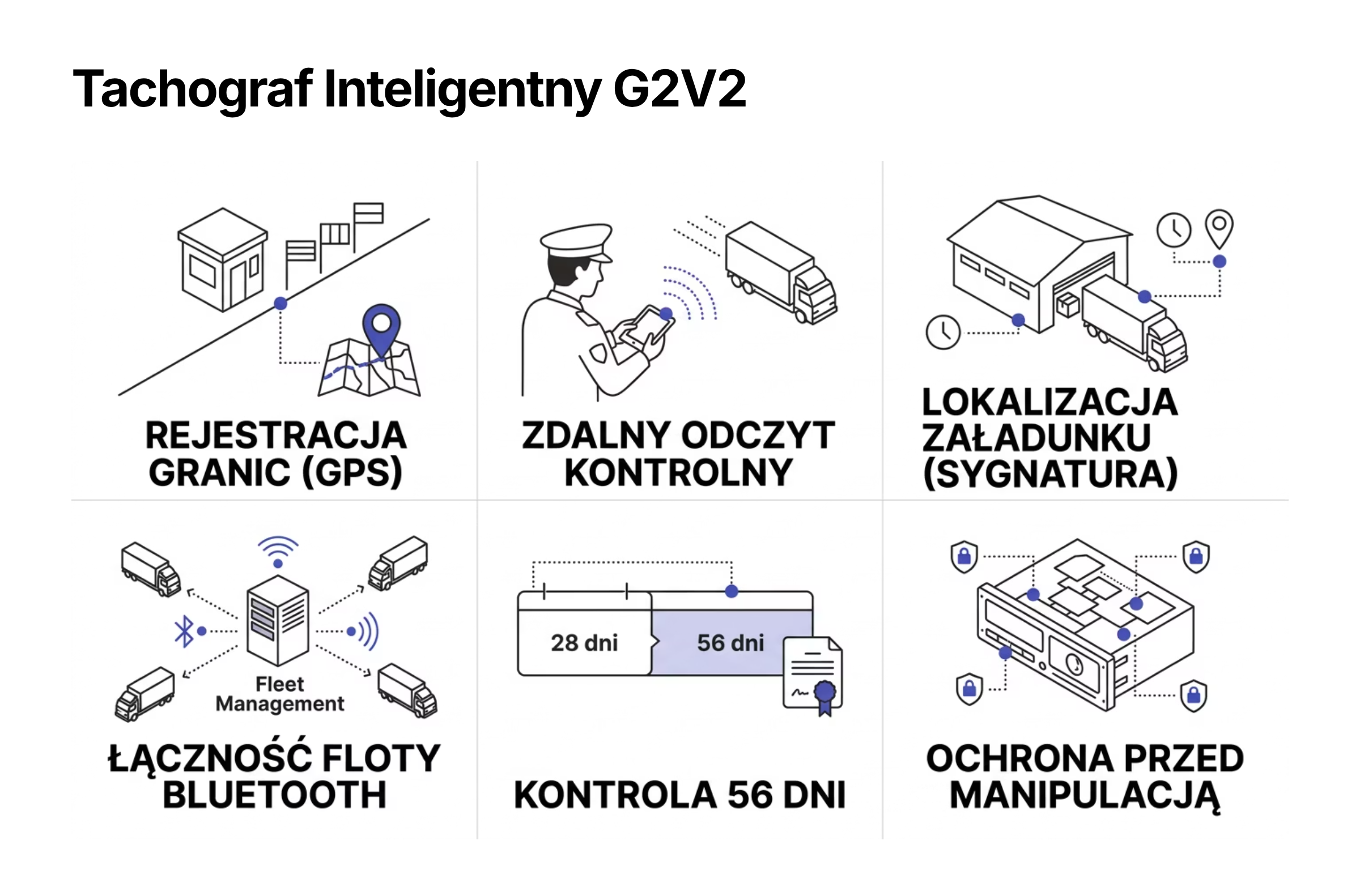
- Automatic registration of border crossings using GPS/GNSS signal without the need for manual data entry by the driver
- Remote data reading by inspection services without having to stop the vehicle on the road
- Registration of loading and unloading locations with the exact time of these operations
- Bluetooth ITS wireless communication with external fleet management systems
- Extension of the retrospective audit period from 28 to 56 days
- Increased resistance to tampering and attempts to interfere with data recording

Remote data inspection is a development that particularly strengthens the effectiveness of surveillance. An inspector can read data from the G2V2 tachograph of a passing vehicle without stopping it on the road, making each trip potentially verifiable without the driver’s knowledge.
When is a tachograph NOT required? Exceptions and exemptions
The regulations provide for a number of exceptions to the obligation to use the tachograph. These derive from Article 3 and Article 13 of Regulation (EC) 561/2006. An important general rule applies: exemption from the obligation depends on the purpose and nature of the carriage, and not solely on the type or weight of the vehicle. The same truck may be subject to the obligation in one circumstance and exempt in another.
A tachograph is not required in the following cases:
- Vehicles of emergency services and public order – ambulance, fire, police, military and civil services supporting these units
- Agricultural and forestry vehicles – tractors and machinery used in agricultural and forestry activities within a radius of up to 100 km from the home base
- Antique and historic vehicles – used only for show or collection purposes, not performing commercial transportation of cargo or passengers
- Vehicles in closed areas – moving only in the areas of ports, airports, mines and industrial plants, not driving on public roads
- Technical test vehicles – subjected to trials and tests without commercial cargo
- Specialized vehicles without cargo space – truck cranes, transmission trucks, technical vehicles for network maintenance
- Roadside assistance within a radius of 100 km from the base – towing and service vehicles providing assistance within a limited range
- Vehicles up to 7.5 tons with alternative propulsion – CNG, LPG or electric providing roadside assistance services within a 100 km radius
Does a vehicle up to 3.5 tons have to have a tachograph?
In principle, no. Vehicles with a GVW of up to 3.5 tons are, in principle, exempt from the tachograph requirement for domestic transport, and this remains the case even after the new regulations come into force in 2026 for routes exclusively within Poland.
An exception appears from July 1, 2026 for international transport. Vehicles with a GVW of 2.5 to 3.5 tons performing commercial international transportation will have to be equipped with a G2V2 tachograph. This applies to vans and delivery vans regularly traveling between EU countries in the course of commercial activities. It is worth remembering the principle of the total GVW of a set: a van with a trailer can exceed the 3.5 ton threshold even if the vehicle itself is below this value, which automatically brings it within the scope of the obligation.
What are the penalties for not having a tachograph or using it incorrectly?
Violations of the mandatory tachograph in a truck are taken seriously by inspection authorities and carry severe financial consequences. Below are the current penalty rates in effect in Poland and EU countries.
| Type of violation | Penalty |
|---|---|
| No tachograph or incorrect type of device | Up to PLN 12,000 (carrier) |
| Tachograph manipulation | Up to PLN 10,000 (driver) + immobilization of the vehicle |
| Violation by the person managing the transport | Up to PLN 2,000 |
| Violations controlled abroad in the EU | Up to €30,000 |
| Serious and repeated violations | Loss of transport license |
The implementation of G2V2 tachographs with remote data reading significantly increases the risk of detecting violations. Road Transport Inspection inspectors can check vehicle data without stopping the vehicle on the road, making inspections routine and difficult to predict.
Failure of the tachograph – what to do?
Failure of the tachograph on the road does not mean that the vehicle must be stopped immediately, but it requires specific actions to be taken as soon as the fault is detected. The procedure is as follows:
- Continue driving to the base or the nearest authorized workshop – regulations allow the carriage to continue in the event of equipment failure.
- Make manual printouts before and after each ride – sign them by hand with annotation of the data that the damaged device could not record automatically.
- Note manually all the required data – driving time, breaks, rests, and the start and end locations of each route.
- Report the malfunction to an authorized tachograph service and repair the device as soon as possible, without exceeding the allowed driving time without a working tachograph.

When is the tachograph mandatory

A separate situation concerns the loss or theft of a driver’s card. The driver may drive for a maximum of 15 days without the card, but must apply for a duplicate within 7 days of the loss. In the case of theft, it is necessary to show confirmation of the police report during a roadside inspection.
How to read and store tachograph data?
The regulations impose specific obligations on the carrier for the regular collection and archiving of tachograph data. Failure to comply with them can result in administrative penalties regardless of whether the drivers’ working time itself was kept correctly.
| Activity | Frequency / deadline |
|---|---|
| Downloading data from the on-board device | At least every 90 days |
| Downloading data from the driver’s card | At least every 28 days |
| Minimum storage of downloaded data | 12 months (recommended 24 months) |
| Printouts at the driver (backward control) | The last 56 days (from 31.12.2024) |
To efficiently manage tachograph data, it is worth using dedicated software. Such systems automate the collection of data from devices and driver cards, generate reports on violations and remind you of upcoming data collection deadlines. Current regulations on drivers’ working time and record-keeping obligations are published by the General Inspectorate of Road Transport, where you will also find sample documents and interpretations of the regulations. Detailed guidelines for carriers are also provided by the International Road Transport Union (IRU) in its industry library.
Manage driver time and tachograph data with Antrans Bis
Obligations related to the mandatory tachograph in a truck are extensive, and the deadlines for replacing equipment with G2V2, downloading data and archiving require constant monitoring. Violation of any of these obligations, even inadvertently, can result in financial penalties or serious problems during a roadside inspection. Our solution allows you to automate the downloading of data from tachographs and driver cards, track compliance with current regulations, and generate reports ready to show during inspections. Contact us and see how we can simplify your company’s fleet management.
Useful articles: How many pallets go into a 40-foot container? | Obtaining transport orders. 5 effective ways for new transports | Subsidies for road transport. Subsidies for transport | Transport documents in road transport in 2026.
FAQ – Frequently asked questions about the obligation to have a tachograph
The question “when is the tachograph mandatory?” is one of the most frequently asked by carriers, drivers and fleet owners. The regulations are extensive, and the new G2V2 obligations introduce additional uncertainties. Below we have compiled answers to the questions that arise most often.
When is a tachograph mandatory?
The obligation applies to trucks with a GVW of more than 3.5 tons used for commercial road transport. Whether every truck must have a tachograph therefore depends primarily on the weight of the vehicle and the purpose of the transport – emergency vehicles, agricultural vehicles or those moving exclusively in closed areas are exempt….
Does every truck over 3.5 tons have to have a tachograph?
Yes, any truck with a GVW of more than 3.5 tons performing commercial road transport must have a tachograph – both in domestic and international transport. Exceptions are strictly defined in Articles 3 and 13 of Regulation (EC) 561/2006 and apply to specific categories of vehicles, such as military, agricultural or emergency vehicles, not to trucks in general.
Does a truck up to 3.5 tons have to have a tachograph?
As a general rule, a truck up to 3.5 tons is not required to have a tachograph in domestic transport, and this provision does not change after 2026 for routes within Poland. An exception applies to international transport: as of July 1, 2026, any truck with a GVW of 2.5 to 3.5 tons performing commercial transport between EU countries must be equipped with a G2V2 smart tachograph.
When is the tachograph mandatory in domestic transport?
A tachograph is mandatory in any truck with a GVW of more than 3.5 tons also in domestic transport. The regulations here do not distinguish between domestic and foreign routes – the criterion is the weight of the vehicle and the commercial nature of the transport. Trucks under 3.5 tons remain exempt on domestic routes regardless of the changes introduced in 2026.
Does a bus have to have a tachograph?
A bus must have a tachograph if it is designed to carry more than 9 people including the driver and regardless of its weight. This applies to tourist buses, employee buses and vehicles for transporting organized groups. An exception is made for city public transport buses operating only within the administrative boundaries of the city. As of July 1, 2026, every truck and bus with a GVW of 2.5 to 3.5 tons in commercial international transportation must also have a G2V2 tachograph.
What is the penalty for not having a tachograph in a truck?
Lack of a tachograph or the wrong type of device in a truck carries a penalty of up to PLN 12,000 for the carrier. A driver faces a fine of up to PLN 10,000 and immobilization of the vehicle for tampering with the tachograph. In EU countries, fines can be as high as €30,000, and with serious and repeated violations, a carrier can lose its transport license.

Dyrektor Generalny | Antrans BiS, OlkuszSebastian Szklarczyk od ponad 15 lat kieruje rozwojem Antrans BiS – firmy transportowej realizującej przewozy w całej Europie. Zaczynał jako Kierownik Działu Spedycji, gdzie zdobywał praktyczne doświadczenie w organizacji przewozów międzynarodowych i zarządzaniu flotą pojazdów na trasach europejskich.
Jako Dyrektor Generalny odpowiada za strategiczne zarządzanie firmą realizującą rocznie ponad 21 000 transportów na kluczowych kierunkach: Polska-Włochy, Polska-Niemcy, Polska-Austria, Hiszpania, Benelux i Skandynawia. Pod jego kierownictwem Antrans BiS rozwinął flotę do 220 pojazdów (własnych i partnerskich) oraz osiągnął terminowość dostaw na poziomie 98%.
Specjalizacja: transport międzynarodowy FTL w całej Europie, logistyka automotive i FMCG, optymalizacja tras europejskich, przepisy drogowe i zakazy ruchu w UE, dokumentacja przewozowa (CMR, VAT-UE, INTRASTAT).
Na blogu Antrans BiS dzieli się praktyczną wiedzą z zakresu spedycji międzynarodowej, przepisów transportowych oraz biznesowych aspektów prowadzenia firmy TSL w różnych krajach europejskich.
Kontakt:
sebastian.szklarczyk@antransbis.pl
Szukasz stałego partnera logistycznego?
Zostaw kontakt - Zadzwonimy!