


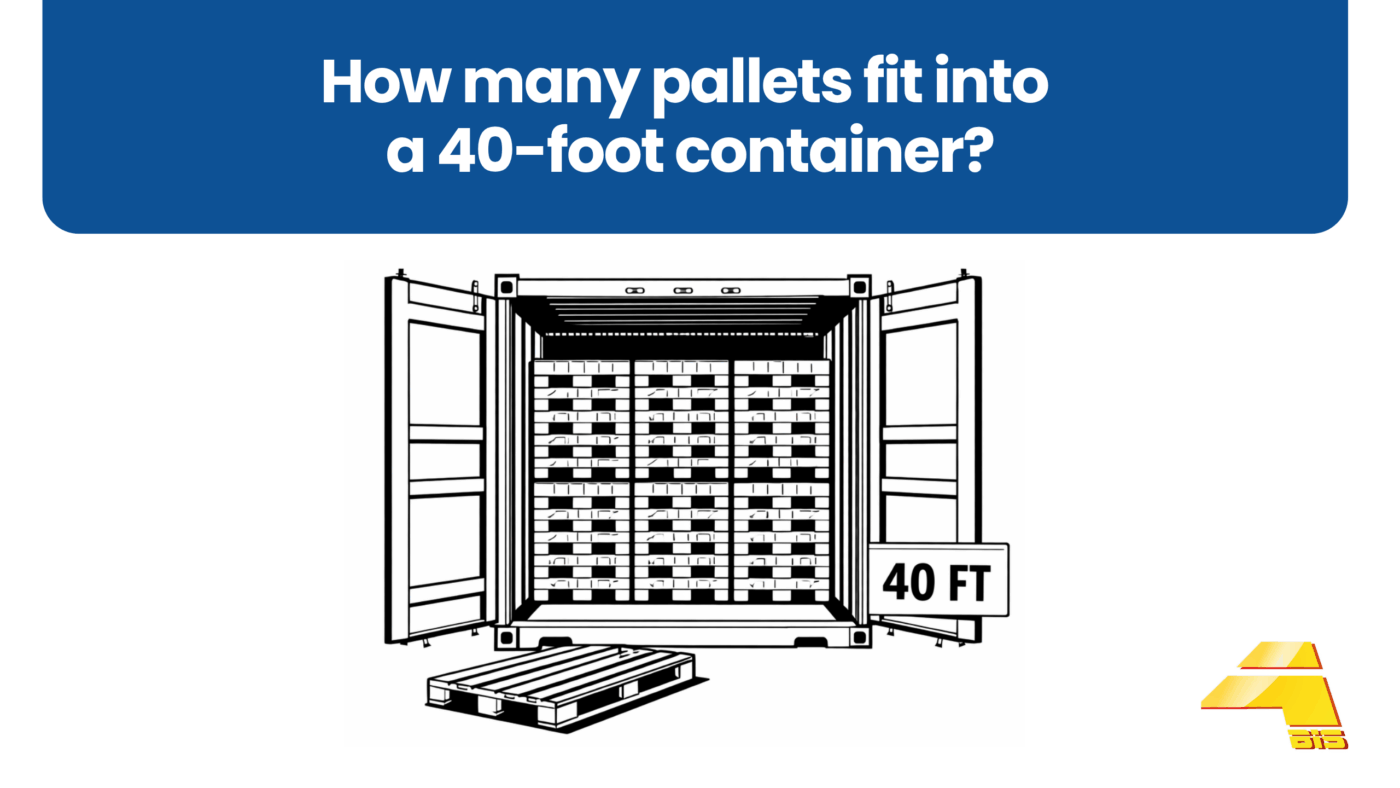
How many pallets go into a container of 40? DV, HC, Reefer, Pallet Wide
The 40′ DV (Standard) container holds 23-25 europallets (80×120 cm) or 20-21 industrial pallets (100×120 cm) in a single layer. The 40′ HC (High Cube) container holds the same number of pallets in one layer, but with a height of 2,695-2,698 mm (vs. about 2,390 mm in DV), it allows stacking – up to 48 europallets in two layers. The 40′ refrigerated (reefer) container holds 23 europallets – 1-2 less than a standard container, because thermal insulation takes up part of the side space.
However, how many pallets go into a 40′ container in a particular case depends not only on the dimensions, but also on the weight limit, loading layout and phytosanitary requirements (ISPM 15). In this article, you’ll find a summary table for all 40′ container types, an explanation of the math behind the numbers 23-25, a section on stacking in HC, weight limits and when the scale stops loading before the volume is filled, and a discussion of the ISPM 15 fumigation requirement for export.
If you are planning to transport pallets overland, also check out our article How many pallets go on a truck? Concrete numbers, tables and explanation, where we discuss the capacity of standard, MEGA and Double Deck trailers.
How many pallets go into a 40 foot container
The table below compiles all 40′ container types in one place. This is the most frequently searched information by logisticians planning FCL sea shipments.
Table 1 – How many pallets go into container 40 – all types (1 layer, goods in pallet outline)
| Container type | Internal dimensions (L × W × H mm) | Europallets 80×120 cm | Industrial pallets 100×120 cm | Max net cargo |
|---|---|---|---|---|
| 40′ DV (Standard) | 12 032 × 2 350 × 2 390 | 23-25 pcs. | 20-21 pcs. | ~26,500 kg |
| 40′ HC (High Cube) | 12 032 × 2 350 × 2 695-2 698 | 23-25 pcs. (1 layer) up to 48 pcs. (2 layers) | 20-21 pcs. | ~26,330-26,580 kg |
| 40′ Reefer (cooler) | 11 550 × 2 260 × 2 260 | 23 pcs. | 20 pcs. | ~27,700 kg |
| 40′ Reefer HC | 11 584 × 2 290 × 2 524-2 552 | 23 pcs. | 20 pcs. | ~26,400-29,280 kg |
| 45′ HC Pallet Wide | 13 556 × 2 478 × 2 698 | 33 pcs. | 24 pcs. | ~27,600 kg |
* Figures given for 1 layer, goods not extending beyond the outline of the pallet and not exceeding the weight limit. For heavier cargo, the number of pallets may be less. Max cargo varies between shipowners (Maersk, MSC, CMA-CGM) – always confirm with your logistics operator.
Internal dimensions of container 40 – DV, HC, Reefer and Pallet Wide
How many pallets go into a container 40 is directly derived from the internal dimensions. Below are detailed data for each type.
Container 40′ DV (Dry Van / Standard)
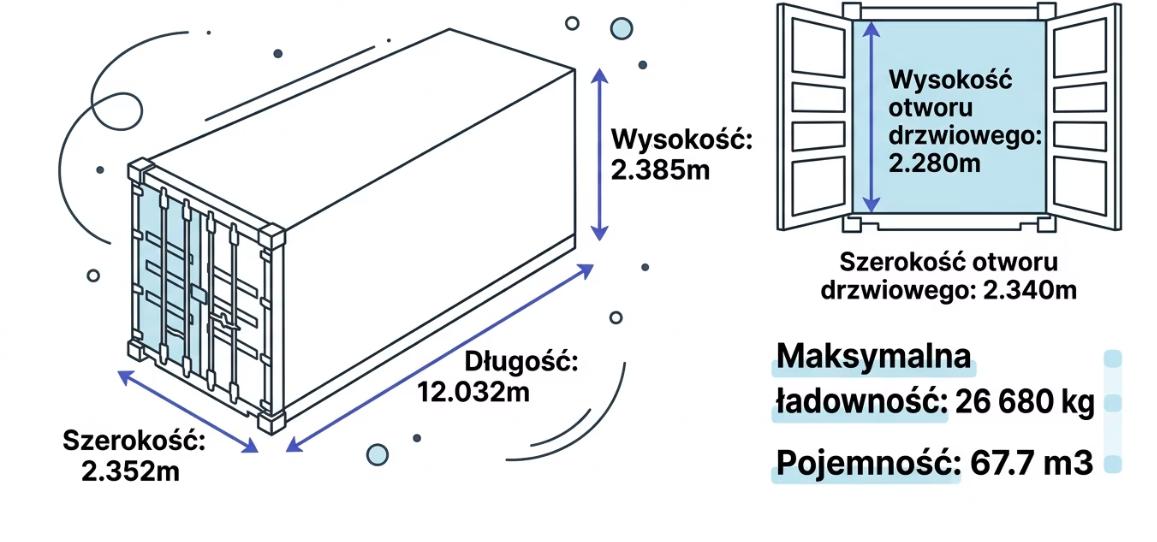
Purpose is mainly dry palletized, bulk cargo. The most popular container on deep-sea routes – is the basis of the entire ISO container system.
Container 40′ HC (High Cube)
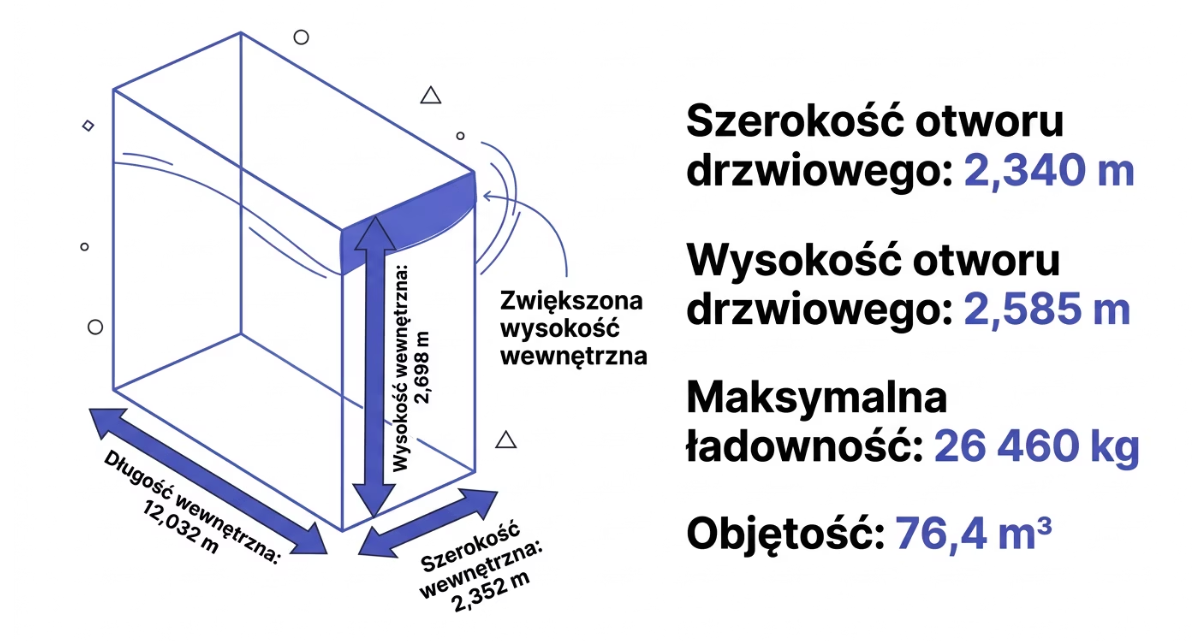
The key difference from DV is the additional approx. 300 mm internal height allows stacking of Euro pallets. EPAL pallet (144 mm) + goods up to 1,200 mm = approx. 1,344 mm × 2 layers = 2,688 mm, which is within 2,695-2,698 mm with a minimum margin. In DV, stacking in two full layers is impossible. 40′ HC is most popular for e-commerce and imports from Asia (textiles, flat-pack furniture, electronics).
40′ Reefer (refrigerated) and 40′ Reefer HC container
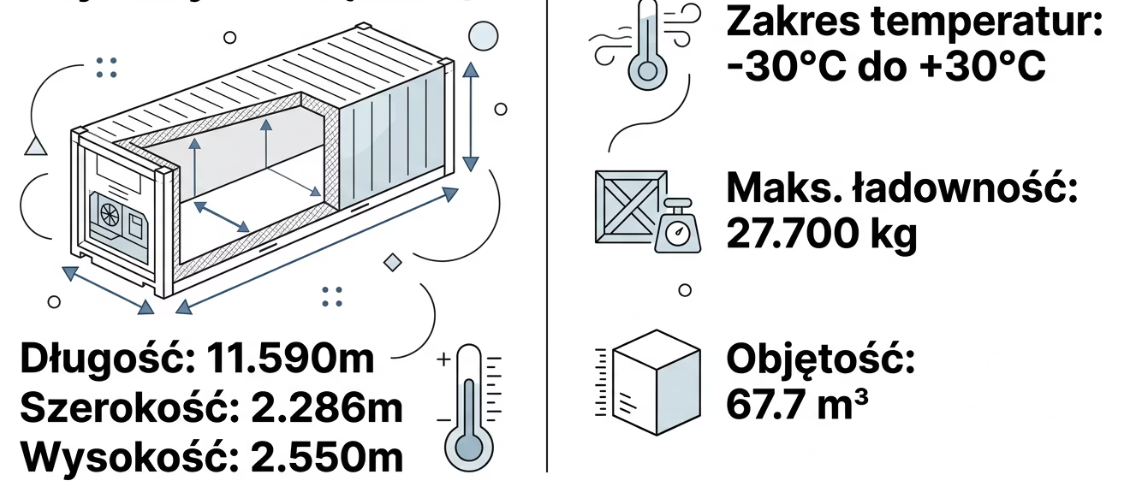
How many pallets go into a 40 refrigerated container? With the same stacking method, 23 Euro pallets and 20 industrial pallets come out. The 40′ Reefer HC container has a slightly higher clearance (about 2,524-2,552 mm) with the same width, resulting in an identical number of pallets per layer.
Important with the reefer container: a circulation gap of at least 12 cm must remain between the cargo and the roof of the container. The cargo vertically must not exceed the red line painted on the reefer floor, and stacking is in practice impossible due to the limited height and air circulation obligation.
Container 45′ Pallet Wide
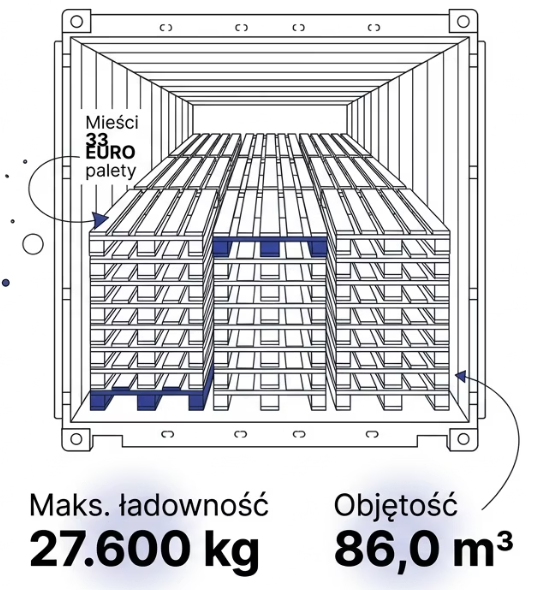
The Pallet Wide (PW) container has an outer width of about 2,500 mm instead of the standard 2,438 mm – a difference of about 62 mm gives an inner width of about 2,478 mm. This allows 3 Europallets (3 × 800 mm = 2,400 mm ≤ 2,478 mm) to fit across the container instead of 2. Internal dimensions: about 13,556 × 2,478 × 2,698 mm. Cubic capacity: approx. 86 m³. Max load: approx. 27,600 kg.
How many pallets go into a 45′ Pallet Wide container? 33 Europallets (45′ HCPW) or 30 Europallets (40′ HCPW). Check with your shipper as to what length you are referring to for your specific order. Pallet Wide container availability is less than DV/HC – available from select shipowners on specific routes.
Why 23, 24 or 25 Euro pallets? The math of pallet layout in a 40′ container
How many pallets go into a 40 DV container is accurately explained by math. None of the popular articles about containers show this arithmetic, and it explains the discrepancies between sources reporting 23, 24 or 25 Euro pallets.
Output: 40′ DV container, internal dimensions approx. 12,032 mm (L) × 2,350 mm (W). EPAL Europallet: 1,200 × 800 mm (±3 mm tolerance according to EPAL standard).
Standard layout (pallets lengthwise, 120 cm along the container): along the container: 12,032 ÷ 1,200 = 10.03 → 10 full rows. Across: 2,350 ÷ 800 = 2.94 → 2 pallets (2 × 800 = 1,600 mm) + 750 mm margin. Result: 10 × 2 = 20 europallets.
Mixed arrangement with rotation at the door (industry standard): 10 longitudinal rows × 2 = 20 pallets. The remaining free space at the door (750 mm margin across) allows 4-5 pallets to be added rotated by 90° (so-called “pin-wheel” layout). The result: 20 + 4 = 24 or 20 + 5 = 25 Euro pallets.
The discrepancy between 23, 24 and 25 is due to pallet dimensional tolerances (±3 mm), door clearances and loading accuracy. The number 23 appears with more conservative planning or an inferior quality container. In a reefer container (internal width of about 2,260 mm), the same rotation technique yields only 3 additional pallets instead of 4-5, hence the result of 23 rather than 24-25.
Stacking pallets in a 40′ HC container – how many pallets in two layers?
How many pallets go into a 40 HC container when stacking? This is a question that e-commerce logisticians and importers of light goods from Asia are asking. The answer depends on three conditions that must be met simultaneously.
Condition 1 – Height. EPAL eupallet (144 mm) + goods up to about 1,200 mm = about 1,344 mm × 2 layers = 2,688 mm. In 40′ HC (2,695-2,698 mm) the margin is 7-10 mm – it fits, but barely. In 40′ DV (approx. 2,390 mm) two full layers (2,688 mm) do not come in. Stacking in standard DV is possible only with very low goods below about 1,100 mm.
Condition 2 – pallet strength. The EPAL Europallet has a permissible dynamic load of 1,000 kg. If the top layer weighs more than 1,000 kg per pallet, the bottom pallet may be damaged. For heavier goods, cardboard or wooden “slip sheets” spacers are necessary.
Condition 3 – load strength. Goods on the bottom pallets must bear the pressure of the top layer. Electronics, glass and products in cartons with low compressive strength are not suitable for stacking.
Table 2 – How many pallets go into a 40′ HC container when stacking
| Variant | Europallets | Condition |
|---|---|---|
| 40′ HC, 1 layer | 23-25 pcs. | standard, no special requirements |
| 40′ HC, 2 layers (max) | up to 48-50 pcs. | stackable goods, weight ≤ 1,000 kg/pallet, height ≤ 1,200 mm |
| 40′ DV, 1 layer | 23-25 pcs. | standard |
| 40′ DV, 2 layers | impossible | Internal height too small (approx. 2,390 mm) |
| 40′ Reefer, 2 layers | impossible in practice | requirement for air circulation + limited height |
* With 48 Euro pallets × 500 kg/pallet = 24,000 kg of cargo – we are approaching the load limit of ~26,330 kg net. With heavier goods, stacking excludes the weight limit before height excludes it.
Weight limit vs. volume limit – when does the scale block loading?
How many pallets go into a container of 40 is one question, but in practice it is equally important: how many tons of cargo can be loaded? With light goods, a full 23-25 pallets is not a problem. With heavy goods, the weight limit stops loading before the container is full by volume.
Weight parameters of the 40′ DV container: maximum gross weight (gross weight) according to ISO 668: about 30,480 kg. Container tare (tare weight): approx. 3,380-4,200 kg (depending on the manufacturer). Maximum net cargo: approx. 26,280-26,780 kg.
Example 1 – light goods (electronics, textiles): 200 kg goods + 25 kg pallets = 225 kg × 24 pallets = 5,400 kg total cargo. Far from the limit of 26,500 kg. Restriction: volume only. Loading of 24-25 pallets possible without problems.
Example 2 – medium goods (household appliances, ceramics): 700 kg + 25 kg = 725 kg × 24 = 17,400 kg. Safely under the limit. 24 pallets without a problem.
Example 3 – heavy goods (ceramic tiles, marble, metal components): 1,500 kg + 25 kg = 1,525 kg × 24 = 36,600 kg – exceeding the limit. Maximum: 26,500 ÷ 1,525 = 17.4 → 17 pallets. Although by volume 24 would fit, the scale blocks loading at 17.
Formula: Max pallets = MIN(max_volume, floor(max_cargo_kg ÷ weight_pallet_with_goods))
VGM (Verified Gross Mass) – a SOLAS requirement as of July 1, 2016: Verified gross mass is mandatory before a container is loaded onto a ship. Method 1: weighing the loaded container. Method 2: sum of weighed cargo + tare + packing materials. VGM is the responsibility of the shipper or exporter. Lack of VGM means prohibition of loading on the ship. VGM requirements are regulated by the International Maritime Organization (IMO).
Fumigation of ISPM 15 pallets – an obligation for export and import by sea
When planning how many pallets go into a container of 40, it’s worth checking right away that the pallets meet phytosanitary requirements – because a lack of ISPM 15 certification could mean the entire shipment is rejected at the border.
ISPM 15 (International Standards for Phytosanitary Measures No. 15) is an FAO standard regulating the treatment of wooden packaging materials (pallets, crates, scantlings) in international trade. Purpose: to prevent the spread of wood pests through transport packaging.
When ISPM 15 is required: export to most countries outside the EU (USA, Canada, Australia, China, Japan, etc.) – ISPM 15-certified wooden pallets always required; import from countries outside the EU – pallets must be ISPM 15-certified. Inside the EU, the certificate is not required because the EU is treated as one phytosanitary area.
Certified treatment methods (pallet marking): HT (Heat Treatment) – heating to a minimum of 56°C for 30 minutes – standard in Poland and the EU; MB (Methyl Bromide) – methyl bromide fumigation – banned in the EU since 2010, but accepted by some importing countries (check current status for destination country); DH (Dielectric Heating) – microwaves – alternative to HT.
Table 3 – ISPM 15 sign on the pallet – what the elements mean
| Marking element | Meaning | Example |
|---|---|---|
| IPPC logo | symbol of the Plant Protection Convention | graphic logo |
| Country code | country of manufacture of the pallet | PL (Poland) |
| Manufacturer number | certified manufacturer’s number | PL-123 |
| Treatment code | phytosanitary method | HT (thermal) or MB (methyl bromide) |
* EPAL-certified Europallets meet the requirements of ISPM 15 – they have HT printing. Pallets without EPAL marking require individual verification before packing the container for export.
Consequences of not having ISPM 15 when exporting: cargo rejection at the border or at the destination port, costly re-fumigation at the shipper’s expense or destruction of pallets, delaying delivery by several weeks. For importers planning shipments from Asia, it’s worth confirming with the supplier with each order that the pallets have the correct HT marking.
Plan shipping container loading – pricing and space optimization
Knowing how many pallets go into a container of 40 is a starting point, but an effective loading plan simultaneously takes into account volume limit, weight limit, stacking capability and phytosanitary requirements. A planning error means either paying for an oversized container or costly handling at the port.
We offer free pre-shipment loading plan optimization, VGM and SOLAS documentation support, access to DV, HC, Reefer and Pallet Wide containers. We provide FCL (full container) and LCL (group cargo) sea freight forwarding. Pricing within 24 hours. Contact us.
Useful articles: How to open a transport company in Poland in 8 steps | Obtaining transport orders. 5 effective ways for new transports | Subsidies for road transport. Subsidies for transport | Transport documents in road transport in 2026.
FAQ – The most common questions about how many pallets go into a 40-foot container
We have collected the questions that most frequently arise when planning an FCL ocean shipment. You’ll find answers about the number of Euro pallets and industrial pallets in different types of 40′ container, the difference between DV and HC, stacking, the weight limit, and the ISPM 15 requirement when exporting outside the EU.
How many pallets go into a 40 DV container in one layer?
A 40′ DV (Standard) container holds 23-25 Euro pallets (80×120 cm) or 20-21 industrial pallets (100×120 cm) in a single layer. The discrepancy between 23 and 25 is due to the stacking method: with a standard longitudinal layout, 20 Euro pallets come out, and an additional 4-5 pieces are obtained by rotating the last row by 90° (“pin-wheel” layout). The dimensional tolerance of EPAL pallets (±3 mm) and the clearances at the door determine whether 24 or 25 come out.
How many pallets go into a 40 HC container and can they be stacked?
The same number of Europallets go into a 40′ HC (High Cube) container as into a DV in a single layer – 23-25 units. The key difference is the interior height of approx. 2,695-2,698 mm instead of approx. 2,390 mm in the DV. This makes it possible to stack two layers of europallets in a 40 HC container: a 144 mm pallet + goods up to 1,200 mm = 1,344 mm × 2 = 2,688 mm, which is within the available height. With light stacking of goods, up to 48 Europallets in two layers enter the 40 HC container.
How many Euro pallets does a 40 Reefer (refrigerated) container hold?
The 40′ Reefer container holds 23 Euro pallets or 20 industrial pallets in a single layer – 1-2 less than the standard 40′ DV. The reason is the narrower usable space: the thermal insulation of the walls (about 100-120 mm thick) reduces the interior width to about 2,260 mm instead of 2,350 mm in DV. Stacking in a 40 Reefer container is in practice impossible due to the mandatory circulation gap of at least 12 cm between the cargo and the roof.
How many Euro pallets go into a 45 Pallet Wide container and how is it different from 40?
The 45′ Pallet Wide container holds 33 Europallets in a single layer – significantly more than the standard 40′ DV. This is due to two differences: the container is longer (13,556 mm vs. 12,032 mm) and wider internally (about 2,478 mm vs. 2,350 mm). The greater width allows you to stack 3 Europallets across (3 × 800 mm = 2,400 mm) instead of 2. Note: a 40′ Pallet Wide container holds 30 Europallets and a 45′ Pallet Wide container holds 33 – always ask about container length when comparing quotes.
When does the weight of the cargo limit the number of pallets in a container 40?
The weight limit of a 40′ DV container is about 26,500 kg of net cargo. With light goods like electronics or textiles (about 200 kg per pallet), 24 pallets weigh a total of about 5,400 kg – no problem. With heavy goods like ceramic tiles or metal components (about 1,500 kg per pallet), the weight limit is reached already with 17 pallets, although by volume 24 would fit. Always calculate both limits and take the lower result: how many pallets the 40 container holds by volume versus how many pallets the weight limit allows.
Do pallets in container 40 need to be ISPM 15 certified for export?
When exporting to countries outside the EU (USA, Canada, Australia, China, Japan and others), wooden pallets loaded into container 40 must have an ISPM 15 certificate confirming phytosanitary treatment. The standard in Poland is HT heat treatment (heating to a minimum of 56°C for 30 minutes) – EPAL Euro pallets have this certification and the HT marking on the beam. Pallets without the certificate may be rejected at the border or at the port of destination, which means costly re-fumigation or destruction of the pallets. Inside the EU, ISPM 15 certification is not required.

Dyrektor Generalny | Antrans BiS, OlkuszSebastian Szklarczyk od ponad 15 lat kieruje rozwojem Antrans BiS – firmy transportowej realizującej przewozy w całej Europie. Zaczynał jako Kierownik Działu Spedycji, gdzie zdobywał praktyczne doświadczenie w organizacji przewozów międzynarodowych i zarządzaniu flotą pojazdów na trasach europejskich.
Jako Dyrektor Generalny odpowiada za strategiczne zarządzanie firmą realizującą rocznie ponad 21 000 transportów na kluczowych kierunkach: Polska-Włochy, Polska-Niemcy, Polska-Austria, Hiszpania, Benelux i Skandynawia. Pod jego kierownictwem Antrans BiS rozwinął flotę do 220 pojazdów (własnych i partnerskich) oraz osiągnął terminowość dostaw na poziomie 98%.
Specjalizacja: transport międzynarodowy FTL w całej Europie, logistyka automotive i FMCG, optymalizacja tras europejskich, przepisy drogowe i zakazy ruchu w UE, dokumentacja przewozowa (CMR, VAT-UE, INTRASTAT).
Na blogu Antrans BiS dzieli się praktyczną wiedzą z zakresu spedycji międzynarodowej, przepisów transportowych oraz biznesowych aspektów prowadzenia firmy TSL w różnych krajach europejskich.
Kontakt:
sebastian.szklarczyk@antransbis.pl
Szukasz stałego partnera logistycznego?
Zostaw kontakt - Zadzwonimy!